The Remedy That Woke Up Mid-Case
The full Third Circuit ruled eight to six that a man with a 2005 drunk-driving conviction may own a gun. On whether the next applicant must first ask the Attorney General, through a process revived while his case was pending, the court split seven to seven.

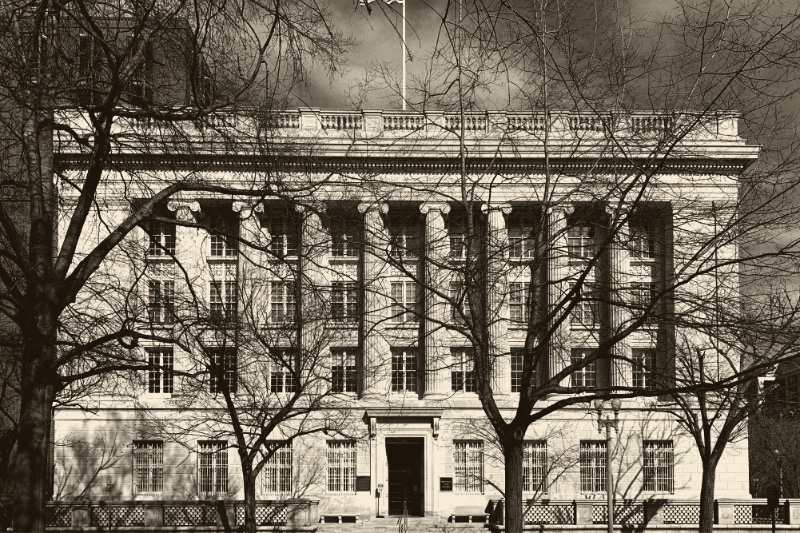
Carol M. Highsmith — Public domain, via Wikimedia Commons
Edward Williams sued in 2017 because, he said, there was no other way to get his gun rights back. On Tuesday 13 October the full Third Circuit agreed that the federal felon-in-possession ban cannot constitutionally be applied to him. But the fourteen judges split seven to seven on a second question that will matter to everyone who comes after him: whether people in his position must now ask the Attorney General first.
The ruling is Williams v. Attorney General, No. 24-1091, argued before the whole court on 11 February. The vote on the judgment was eight to six.
A misdemeanour that counts as a felony
Federal law, 18 U.S.C. § 922(g)(1), bars gun possession by anyone convicted of a crime “punishable by imprisonment for a term exceeding one year.” The test is what the sentence could have been, not what it was. Williams was charged with drunk driving in Pennsylvania in 2000 and went through a first-offender programme. In 2005 he was convicted of driving at the state’s highest rate of alcohol. As a second offence, it carried up to five years. Pennsylvania labels it a first-degree misdemeanour; under the federal statute it counts. He was sentenced to between ninety days and two years and served the custodial part at home.
The opinion records that he went on owning guns and, in 2007, answered no on a state police form asking whether he had ever been convicted of a crime punishable by more than a year. In 2015 his lawyer told him he was prohibited. He gave up his firearms and, in 2017, sued for a declaration that the ban was unconstitutional as applied to him. Judge John M. Younge of the Eastern District of Pennsylvania agreed, and the government appealed.
What the majority held
Judge Paul Matey wrote for seven judges: himself and Judges Hardiman, Bibas, Porter, Phipps, Bove and Mascott. The tradition of disarming people, he wrote, rests on physical danger, not on the label “felon,” and the government had not shown that Williams is dangerous now. “He has done nothing violent, let alone dangerous, for over twenty years,” the opinion says, and an expert examination found him “without addiction or violent tendencies.” Chief Judge Michael Chagares joined the judgment, making eight. The same day, in United States v. Bost, the court upheld the ban as applied to a man with a conviction for terroristic threats arising from a 2002 carjacking.
The remedy that slept
The split is over 18 U.S.C. § 925(c). It lets the Attorney General lift a federal firearms disability if the applicant “will not be likely to act in a manner dangerous to public safety,” with review of a denial in district court. For most of its life it did not work. The authority was delegated to the Bureau of Alcohol, Tobacco, Firearms and Explosives in 1975, and from 1992 Congress barred the bureau from spending money on the applications, so they were returned unread. In 2002 the Supreme Court held that without an actual denial there was nothing for a court to review. That is the gap Williams’s 2017 complaint relied on.
The remedy came back while his case was pending. In March 2025 the Attorney General withdrew the bureau’s delegation and the department began granting relief directly; Chief Judge Chagares counts “dozens” of grants published in the Federal Register. A final rule setting out the process was signed on 13 August 2026, published on 20 August and took effect on 21 September, according to Judge Arianna Freeman’s opinion.
The government argued that this turns the ban into a temporary restraint and that Williams should go through it. The seven-judge majority refused. The process had “sat dormant since 1992” and was now “a slow trickle of relief available only upon invitation,” Matey wrote, quoting the government’s lawyer at argument: “we have not opened up the process to the public as a whole.” Congress had imposed no exhaustion requirement, and nothing supported “holding a constitutional right in abeyance while the Government gradually comes into compliance.”
Seven on the other side
The other seven judges took the opposite view of the future, while dividing on Williams himself. Chagares, joined on this point by Judge Cheryl Ann Krause, wrote that people seeking restoration “must first pursue their claims through the revitalized administrative process,” but excused Williams because of how long his case had run. Freeman, joined by Judges Montgomery-Reeves and Chung, wrote that once the process is available, “absent extraordinary circumstances,” people “should not be permitted to bypass that process by filing declaratory judgment actions.” She would also have sent Williams’s case back for fact-finding on whether he is dangerous now. Judge Patty Shwartz, joined by Krause and Judge Restrepo, would have dismissed his suit so that he could apply under § 925(c), and held that his DUI conviction justified the ban.
Counted that way, the part of Matey’s opinion rejecting the exhaustion argument carries seven of fourteen votes, and seven judges wrote or joined opinions saying the opposite for future cases. The opinions do not say what an even division on that point leaves as the rule in the circuit, and this publication does not guess.
What follows
Williams has his declaration. The next person in his position will file in a circuit where half the court thinks a lawsuit is the right road and half thinks the door is now at the Justice Department. Elsewhere the answer can turn, as it does in other corners of federal law, on which circuit a person is in. Nothing in the opinions says whether the government will ask the Supreme Court to review either case.
Further reading
- Opinions, Williams v. Attorney General, No. 24-1091 (en banc, 13 October 2026)U.S. Court of Appeals for the Third Circuit
- Opinions, United States v. Bost, No. 24-1719 (en banc, 13 October 2026)U.S. Court of Appeals for the Third Circuit
- 18 U.S.C. § 925(c), relief from disabilitiesLegal Information Institute
Ruth Okonkwo writes for The 13th Bell on law. This piece was edited and fact checked before publication.
Get The 13th Bell in your inbox