Four Plaintiffs, Not the Order
A federal judge has barred the government from penalising two advocacy groups and two of their members for work aimed at the International Criminal Court. He left the executive order, the designations and everyone who did not sue where they were.

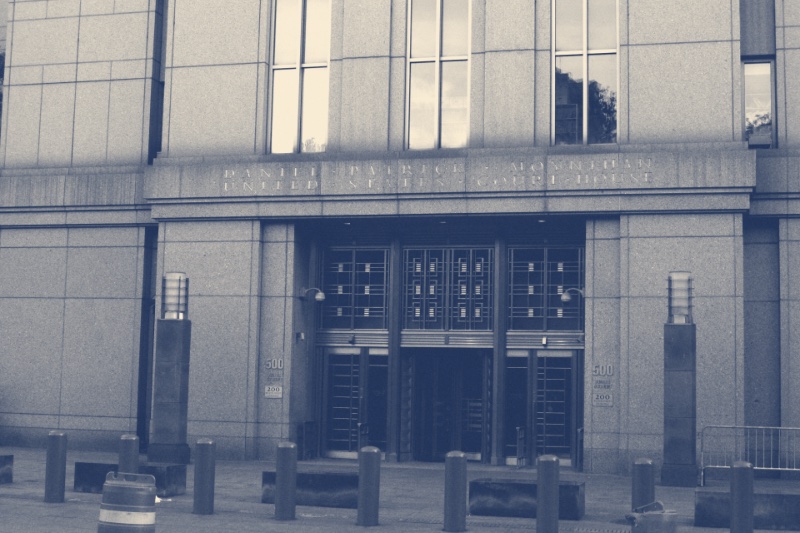
APK — CC BY-SA 4.0, via Wikimedia Commons
A federal judge in Manhattan on Tuesday 13 October barred the government from fining or prosecuting two advocacy groups and two of their members for work they want to do with the International Criminal Court. Judge Jesse M. Furman granted the preliminary injunction “in substantial part” in Democracy for the Arab World Now, Inc. v. Trump, No. 26-cv-5957 in the Southern District of New York. In the same 30-page opinion he refused to strike down the executive order behind the sanctions, refused to enjoin the President, and refused to extend the protection to anyone who had not sued.
The plaintiffs are DAWN, a US-based nonprofit, the Taxpayer Alliance Against Genocide (TAAG), an unincorporated association of ten American taxpayers, and TAAG’s president and treasurer, Tarik Kanaana and William Doares. The ruling came four days after the Treasury’s Office of Foreign Assets Control added the court itself to its list of Specially Designated Nationals. The opinion does not mention that listing.
What the order covers
The operative sentence is narrow. All defendants except President Trump are enjoined “from enforcing IEEPA’s civil or criminal penalty provisions against Plaintiffs for the conduct specifically addressed in Plaintiffs’ Complaint and in this Opinion and Order, to the extent that such conduct is alleged to have been committed in violation of the 2025 Order’s Services Prohibition.” The 2025 Order is Executive Order 14203 of 6 February 2025. Its Section 3 prohibits “the making of any contribution or provision of funds, goods, or services by, to, or for the benefit of” anyone designated under it. The penalties at stake are serious: under the International Emergency Economic Powers Act a civil fine can reach $377,700 or twice the value of the transaction, and a wilful violation carries a fine of up to $1 million and, for an individual, up to twenty years in prison.
The conduct is set out in the plaintiffs’ declarations. DAWN made submissions to the ICC prosecutor under Article 15 of the Rome Statute about alleged crimes by Israeli officials and the role of US officials in them, and worked with three Palestinian human rights groups, Al-Haq, Al Mezan and the Palestinian Centre for Human Rights, and with Francesca Albanese, the UN special rapporteur on the occupied Palestinian territory. All four were designated in 2025. DAWN stopped that work after the order. Members of TAAG have been preparing a submission to the prosecutor with counsel since October 2025 and have not sent it. Both asked OFAC in writing whether the work was lawful, in February and March of this year. According to the opinion, OFAC answered neither question.
Why the judge ruled as he did
Furman had decided the question before. In Rona v. Trump, in 2025, he held that the same services prohibition was a content-based restriction on two law professors’ speech, because whether they could teach, advise or write depended on whether their speech benefited a designated person, and that it failed strict scrutiny because it reached far more speech than the government’s interest required. Judge Katherine Polk Failla had reached the same view of identical language in the 2020 order. This case, he wrote, “is on all fours with Rona,” and the government “makes no effort even to argue that Rona got it wrong.” Because the First Amendment claim was enough, he did not reach the plaintiffs’ argument that the statute itself exempts informational materials and personal communications.
He was explicit about what survives. The injunction “does not disturb the Government’s authority to designate persons for sanctions under Section 1 of the Order.” It leaves in place the power to penalise the provision of “funds” or “goods” to designated persons, and it allows the services ban to be enforced where the First Amendment is not engaged, “for example, by applying it to financial services rather than to speech-related advocacy services.”
Four plaintiffs, not everyone
The plaintiffs asked for more, and the refusals are the larger part of the ruling. Furman declined to enjoin the President, following Judge Failla’s reasoning that the officials who designate and enforce can be enjoined instead. He declined to declare the order unconstitutional on its face, holding that its speech-related applications are “relatively limited” against its legitimate sweep. And he declined a universal injunction, partly because the request first appeared in the plaintiffs’ reply brief and partly because the Supreme Court in Trump v. CASA last year confined relief to what the plaintiffs before the court need. This publication has written about how far a single district judgeThis publication has written about how that decision changed what a single judge can order.rsquo;s order should reach. The plaintiffs argued that their collaborators, counsel and invitees remain exposed; the judge called those arguments “not necessarily without force” but said the government should be heard on them first.
The result is a remedy that travels with the litigant. The same order is under challenge in two other cases on Furman’s docket, Prost v. Trump and American Friends Service Committee v. Trump. Each plaintiff that wants this protection has to come to court for it.
What the plaintiffs say, and what comes next
DAWN said in a statement that it would resume its ICC advocacy immediately and work with the Palestinian groups and Albanese “to the fullest extent permitted by law,” and that TAAG would finalise its submission. “The court ruling makes clear that the law does not permit barring Americans from advocating for justice at the ICC or working with human rights defenders that this administration sanctioned solely for calling for justice for U.S. and Israeli war crimes,” said Omar Shakir, DAWN’s executive director. The groups’ lawyer, Joseph Pace, called the decision “a victory for the First Amendment and an important step in unraveling the ICC sanctions regime.” As the opinion is written, it unravels nothing beyond these four parties.
The next date is Tuesday 20 October. Furman did not merge the hearing with a trial on the merits as he did in Rona, but wrote that his reasoning “may be enough to resolve this case on the merits,” and ordered the parties to file a joint letter by then saying whether anything remains to be litigated and, if not, whether he should enter a permanent injunction and final judgment. That letter is also the first place either side can say what the court’s own designation, four days before the ruling, changes for these plaintiffs.
Further reading
- Opinion and order granting in part the motion for a preliminary injunction, Democracy for the Arab World Now, Inc. v. Trump, No. 26-cv-5957 (13 October 2026)U.S. District Court, S.D.N.Y.
- Docket, DAWN v. TrumpCourtListener
- International Criminal Court designation and general licenses (9 October 2026)U.S. Treasury, Office of Foreign Assets Control
- International Criminal Court-related sanctionsU.S. Treasury, Office of Foreign Assets Control
- U.S. Court Blocks Enforcement of ICC Sanctions against Groups Advocating for Palestinian RightsDAWN
Nadia Belkacem writes for The 13th Bell on diplomacy and migration policy. This piece was edited and fact checked before publication.
Get The 13th Bell in your inbox