The Directive, Not the Law
A federal judge left New Hampshire’s student-ID law alone and blocked only the Secretary of State’s instruction that went further. The state has asked the Supreme Court to restore it before the 3 November election, and Justice Jackson wants an answer by Monday.

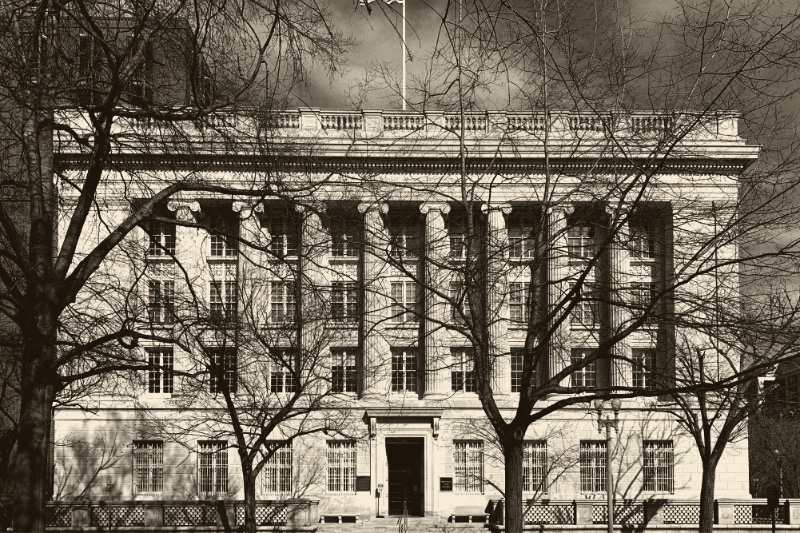
Farragutful — CC BY-SA 4.0, via Wikimedia Commons
New Hampshire has asked the Supreme Court to pause a federal injunction that leaves the state’s student-ID law in force. The application, Scanlan v. Coalition for Open Democracy, No. 26A512, was docketed on 15 October and submitted to Justice Ketanji Brown Jackson, the circuit justice for the First Circuit, according to the Court’s docket. She has called for a response by 11 a.m. on Monday 19 October. The Republican National Committee filed a brief supporting the state the next day.
The election is on 3 November, seventeen days from Saturday. What is at stake is narrower than the coverage of the law has suggested: one line of guidance about what a poll worker may look at when a voter cannot show a listed ID.
A law and a directive
House Bill 323, which Governor Kelly Ayotte signed on 3 April and which took effect on 2 June, according to New Hampshire Public Radio, removed student IDs from the list of documents that prove a voter’s identity. It did not touch a separate provision, RSA 654:12(I)(d)(4), that lets an official accept “any other evidence that reasonably establishes that it is more likely than not that the person is who they claim to be.”
The Secretary of State, David Scanlan, went further. In an email to election officials on 23 April, which the court calls the April Directive, his office said student IDs could not be used to prove identity at all. The Coalition for Open Democracy, a voter education group, sued on 11 August, No. 1:26-cv-00647-JL. Judge Joseph N. Laplante declined to block anything before the 8 September primary, citing the Purcell principle that federal courts should not change election rules on the eve of a vote.
Two dates, one ruling
Laplante ruled on the general election at 9:23 p.m. on Friday 2 October, in a 51-page order; on Monday 5 October he issued a separate preliminary injunction order setting out its terms. That is why reports have given both dates, and the state’s application lists both. He refused to enjoin HB 323. “The State has offered no independent justification for that broader prohibition,” he wrote of the directive, and “even a minimal burden on the right to vote must be justified by the State’s interests.” He enjoined the directive “to the extent it prohibits or discourages election officials from considering student IDs as evidence of voter identity,” and ordered Scanlan to issue revised guidance “as soon as practicable.”
Refusing a stay on 7 October, Laplante described what that guidance change amounts to. The Secretary’s own Election Procedure Manual already tells supervisors that “any other evidence” may be used to prove identity, except that a “student identification card cannot be used to prove identity.” His order, he wrote, effectively requires the Secretary “to remove the single line.” A student ID is still not a listed ID. It becomes something an official may weigh.
How it reached the Court
The state appealed on 5 October and asked the First Circuit for a stay the next day. On 7 October the panel of Judges Gelpí, Aframe and Dunlap sent it back to ask the district court first, which refused that evening. On 14 October the panel denied a renewed motion, with Judge Dunlap noting that he would have granted the stay. The state filed in Washington on 15 October.
Its argument rests on timing. The application says the order came 32 days before the election, after five months in which local officials were trained on the directive and the Secretary’s office ran radio ads, printed polling-place posters and published student voting guides. It says the plaintiff waited more than four months after the law was enacted to sue. It asks for an immediate administrative stay while the Court decides. “New Hampshire has a strong interest in ensuring that its election laws are applied consistently,” Michael Garrity, the state Department of Justice’s communications director, told the New Hampshire Union Leader.
The same paper quoted Ross Berry, the Republican chairman of the House Election Laws Committee: “It is far too close to the election to be changing the rules.” Liz Tentarelli, president of the League of Women Voters of New Hampshire, told InDepthNH that “if all you have is your student ID, you should be allowed to vote.”
Which side is the status quo
Both sides invoke the same principle. The state says the Court should not let a judge change the rules weeks before a vote. Laplante’s stay ruling said the injunction “removes a barrier; it does not impose any new procedure,” and that the real risk of confusion came from leaving the state’s existing guidance untouched. A stay would put the directive back for 3 November. It would not revive or strike any part of HB 323, which neither the injunction nor a stay touches.
The response is due on Monday morning, fifteen days before the polls open.
Further reading
- Docket, Scanlan v. Coalition for Open Democracy, No. 26A512Supreme Court of the United States
- Application for a stay (15 October 2026)New Hampshire Department of Justice
- Appendix: district court orders of 2, 5 and 7 October and First Circuit orders of 7 and 14 October 2026Supreme Court of the United States
- Judge says NH Secretary of State went too far on student IDs for votingNew Hampshire Public Radio
- Legal battle over use of student IDs to vote in NH heads to U.S. Supreme CourtInDepthNH
Miriam Halloway writes for The 13th Bell on law. This piece was edited and fact checked before publication.
Get The 13th Bell in your inbox