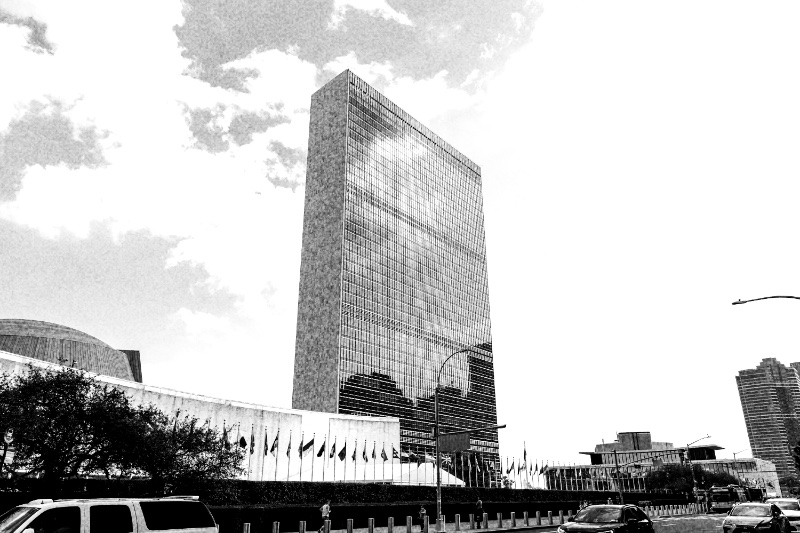
The Other Side of the Rostrum
Masoud Pezeshkian answered Trump from the same lectern a day later, in the plural rather than the singular. The speech was a record entered for an audience of one, whose envoys had met Iranian officials the night before.

The rostrum in the General Assembly hall does not change between speakers. What changes is the grammar.
On Tuesday Donald Trump stood at it and spoke almost entirely in the first person singular, announcing decisions taken elsewhere and a choice on Iran that he described as his to make: a deal, or to “annihilate” the country. On Wednesday morning Masoud Pezeshkian stood at the same lectern and spoke in the plural, and he did not announce anything at all.
He began by answering. “The United States president described us as terrorists,” he said. “We have been the victims of terrorism.” He held up photographs of dead schoolchildren. He returned to the opening days of a war that began on 28 February and is now in its seventh month, and to the school in the south where Iran says more than 150 children were killed, and to the killing of the country’s supreme leader, Ali Khamenei. “We have only defended ourselves,” he said. “We are not terrorists.” And later: “Yes they did hit us, but we did not bend the knee.”
It is a rare thing for a head of state to address the Assembly while at war with the country hosting it. Nothing in the speech asked the hall to do anything, because there is nothing the hall can do.
Two grammars in two days
This magazine read Trump’s address on Tuesday as an accurate map of where decisions are made. Pezeshkian’s is the same map seen from the other end. The singular belongs to a government that can choose; the plural belongs to one that can only absorb and record. A state with leverage uses the rostrum to announce. A state without it uses the rostrum to testify.
That is not a criticism of the speech. Testimony is the only instrument an outmatched government has that costs nothing and cannot be confiscated. It is also the thing the General Assembly was built to provide, and very nearly the only thing: one country, fifteen minutes, on the record, whatever the balance of forces outside the building.
The meeting that was not on the programme
While the hall was being used for the record, the negotiation was happening in a side room. On Tuesday, Steve Witkoff and Jared Kushner met Iranian officials for about three hours on the sidelines of the gathering, the first such contact since the June ceasefire collapsed, with Qatar carrying messages between them. Trump called it “a very good meeting” and said almost nothing else. Iran’s foreign ministry spokesman, Esmail Baghaei, said the contacts were “not anything new,” and restated the demands: end the blockade of Iranian ports, release the frozen assets.
Both characterisations are self-serving and both may be true. What is worth noticing is the asymmetry in who can afford vagueness. The American side has no need to specify, because it is not the party asking for the war to stop. The Iranian side cannot afford to appear to be asking, which is why the demands arrive through a spokesman in Tehran rather than from the rostrum in New York. Marco Rubio said the President remained open to meeting Pezeshkian in New York. Nothing was scheduled.
Admitted, and managed
Pezeshkian is in the building because a document signed in 1947 obliges the United States to let him in, irrespective of the relations between the two governments. He is in the building on the host’s terms. His media team was refused visas. His delegation’s movements in New York are confined to a narrow perimeter, and its members are barred from buying luxury goods. The obligation runs to admission; everything after admission is discretion, and the discretion belongs to the government he came to answer.
The same asymmetry runs through the substance. The Strait of Hormuz, where commercial traffic is still below prewar levels, is the one instrument Iran holds that the United States cannot ignore, and it is the instrument that makes the rest of the world impatient with Tehran rather than with Washington. Iran’s leverage and Iran’s isolation are the same object seen from two sides.
What the hall is for
The Assembly cannot end this war. The organ that could is the Security Council, where the government prosecuting the war holds a veto, and which appeared in Trump’s speech exactly once, thanked for a resolution condemning attacks on shipping. So Wednesday’s speech was addressed past the hall: to governments whose trade runs through the strait, to a domestic audience in Iran that needed to hear its president refuse, and, most of all, to the man who stood at the same lectern a day earlier and said the decision was his.
Nothing said into a microphone on First Avenue will change what that man decides. But the record is what an institution can offer a state that cannot win, and the record has a use. It is the thing a negotiation is measured against later, when the terms are written down and someone has to explain what was claimed at the time. Pezeshkian used his fifteen minutes to make the claim as specific as possible: the names, the numbers, the school. The three hours that may actually settle the war happened the night before, in a room with no rostrum in it and no transcript.
Further reading
- Iran’s president speaks at the United Nations in rare wartime addressThe Associated Press
- Live updates: Iran’s president addresses UN as push to end war looms over General AssemblyCNN
- Iran delegation to present narrative of resilience, diplomacy at UNGAAl Jazeera
- UN General Assembly live: Iran ‘victim of terrorism’ — Pezeshkian to TrumpAl Jazeera
Iris Nakamura writes for The 13th Bell on world. This piece was edited and fact checked before publication.
Get The 13th Bell in your inbox