Poland’s Constitutional Tribunal Has Two Rival Leaders After a Judge Suspends Its President
A judge elected by the current Sejm says she has suspended the Tribunal’s president for a month under a law written for ordinary courts. President Nawrocki says the government has seized a constitutional organ. The Constitution answers neither claim directly.

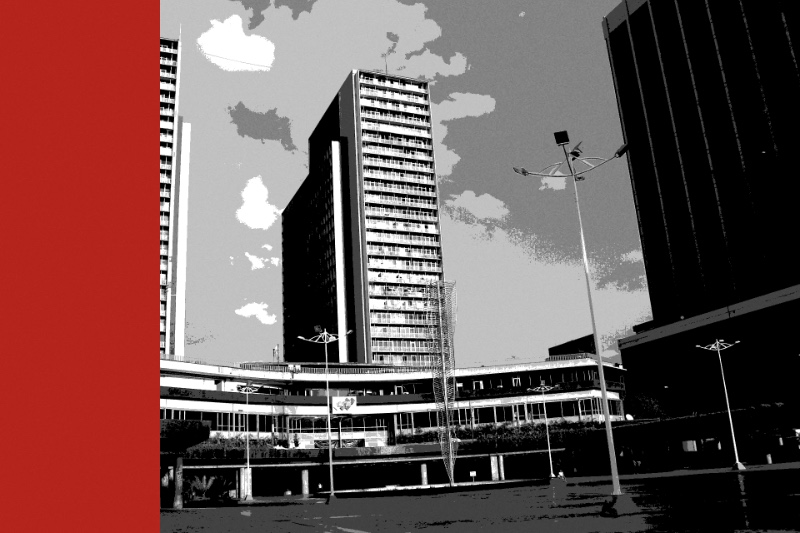
Adrian Grycuk — CC BY-SA 3.0 pl, via Wikimedia Commons
Poland’s Constitutional Tribunal has two people claiming to run it. On Friday 30 October Judge Anna Korwin-Piotrowska, one of the judges elected by the current Sejm, ordered a one-month break in the duties of the Tribunal’s president, Bogdan Święczkowski, and its vice-president, Bartłomiej Sochański, and said she would lead the court in their place, Notes From Poland reported.
Święczkowski does not accept that she is a judge at all. The Tribunal’s account on X posted that “Korwin-Piotrowska is not a TK judge,” and that an “unlawful takeover of the TK’s website has occurred.” Police were deployed to the grounds on Friday evening and detained three people, Al Jazeera reported. President Karol Nawrocki turned his aircraft back from a trip to Senegal and overnight entered the building himself.
Both sides describe the other as acting outside the law. The useful question is narrower: which written rule each one is relying on, and whether that rule says what they need it to say.
What did Judge Korwin-Piotrowska order?
An “immediate break” in Święczkowski’s duties, for no more than a month. The order, as quoted by the legal news service Prawo.pl, rests on Article 130 §1 of the 2001 Law on the System of Common Courts, read together with Article 10 §1 of the 2017 Supreme Court Act and Article 19 of the 2016 Act on the status of Tribunal judges. Article 130 lets a court president or the Minister of Justice suspend a judge caught in the act of an intentional crime, or where the nature of the act or the authority of the court requires immediate removal, until a disciplinary court rules and for no longer than a month. She claims the power to act as the judge with the longest judicial service, under Articles 11 and 12 of the Act on the organisation of the Tribunal, Prawo.pl reported.
The order gives three reasons, according to Prawo.pl: that Święczkowski kept five judges elected by the Sejm on 13 March 2026 from sitting and so blocked the General Assembly of judges from adopting the Tribunal’s 2027 budget; that he did not comply with an interim measure from the European Court of Human Rights of 5 May 2026, which Święczkowski has argued the Strasbourg court had no authority to issue, Notes From Poland reported; and that he allowed politicians into the building during the 14 October swearing-in of Judge Maciej Berek. Separately, the Justice Minister and Prosecutor General, Waldemar Żurek, sent the Tribunal five requests to lift immunity, four concerning Święczkowski and one concerning Sochański, Rzeczpospolita reported.
What does the Constitution say about who runs the Tribunal?
Very little, and none of it about suspension. Article 194 provides that the Tribunal “shall be composed of 15 judges chosen individually by the Sejm for a term of office of 9 years,” and that its president and vice-president “shall be appointed by the President of the Republic from amongst candidates proposed by the General Assembly of the Judges,” according to the English text published by the Constitute Project. Article 195 makes its judges “subject only to the Constitution.” Article 196 says a Tribunal judge “shall not be held criminally responsible or deprived of liberty without prior consent granted by the Constitutional Tribunal.” Everything else, Article 197 leaves to statute. The Tribunal’s past rulings have already figured in another dispute this month, over the majority needed to send the central bank governor to the State Tribunal, and Romania’s courts have spent the same weeks splitting over Călin Georgescu’s arrest.
That is where the argument sits. Marcin Matczak, a constitutional law professor, wrote that the legal basis is non-existent because a justice minister has no supervisory role over the Tribunal, Prawo.pl reported. The following table, which is this publication’s own summary of the provisions each side has invoked, sets out what each one covers.
| Step | Taken by | Provision relied on | What the provision covers |
|---|---|---|---|
| One-month break for president and vice-president | Korwin-Piotrowska | Common Courts Law art. 130 §1, via Supreme Court Act art. 10 §1 and Tribunal judges’ status act art. 19 | Suspension of a common-court judge by a court president or the justice minister, pending a disciplinary ruling |
| Acting leadership of the court | Korwin-Piotrowska | Tribunal organisation act arts. 11 and 12 | Substitution by the longest-serving judge |
| Five requests to lift immunity | Żurek | Constitution art. 196 | Criminal liability of a Tribunal judge needs the Tribunal’s consent |
| Non-recognition of the new judges | Święczkowski, Nawrocki | Manner of swearing-in | The new judges took their oaths in the Sejm, not before the President |
| Appointment of a president of the court | The President of the Republic | Constitution art. 194(2) | From candidates proposed by the General Assembly |
How many judges does each side count?
The outlets do not agree. Notes From Poland reports that the Sejm has chosen eight judges this year, in theory a majority of the 15 seats, and that Nawrocki has refused to swear in five of them; Al Jazeera reports that he has refused three of six. Korwin-Piotrowska is one of those the President has not sworn in, according to Al Jazeera and Rzeczpospolita, which reports that Święczkowski does not recognise her because she took her oath before the Marshal of the Sejm. Seven of the judges elected this year entered the building on Friday under escort from the State Protection Service, through a gate from the Prime Minister’s chancellery, Notes From Poland reported, citing the Tribunal’s spokeswoman, Weronika Ścibor.
The political positions are stated plainly on both sides. “Restoring the rule of law is our duty,” Prime Minister Donald Tusk wrote, adding that it “requires decisive action. There is no other way,” according to Al Jazeera. Early on Saturday the President’s chief of staff, Paweł Szefernaker, described “a forcible takeover of a constitutional organ of the state,” Euronews reported. Żurek said, “The president’s behaviour alarmed me enormously,” after footage showed scuffles as Nawrocki entered with the First President of the Supreme Court, Zbigniew Kapiński. Two ambassadors, Jakub Kumoch in China and Paweł Soloch in Romania, resigned in protest, Rzeczpospolita reported.
What happens next?
Korwin-Piotrowska has called a General Assembly of the Tribunal’s judges for 3 November to adopt the 2027 budget, Rzeczpospolita reported. That is four days after her order. By this publication’s arithmetic, the one-month ceiling in Article 130 runs out on or about 30 November, unless a disciplinary court rules first; it has not been reported which body would sit as that court for a Tribunal judge. The five immunity requests must, under Article 196, be decided by the Tribunal itself.
That last point is the knot. Whether the Tribunal can consent to prosecuting its president depends on who is entitled to sit, and who is entitled to sit is the question the requests were filed to settle.
Further reading
- Chaos at Poland’s constitutional court as government-backed judges seek to oust chief justiceNotes From Poland
- Spór o Trybunał Konstytucyjny: Anna Korwin-Piotrowska zawiesza w czynnościach ŚwięczkowskiegoPrawo.pl
- Chaos w Trybunale Konstytucyjnym. Wyjaśniamy sytuację w dziesięciu punktachRzeczpospolita
- Poland political crisis: Constitutional court in chaos as Nawrocki accuses government of staging power grabEuronews
- Polish police deployed to top court after head judge suspendedAl Jazeera
- Poland’s Constitution of 1997 with Amendments through 2009Constitute Project
Thomas Rennick is a house byline used by The 13th Bell’s World desk. This piece was checked against the sources listed below before an editor approved it. See How we use AI.
Get The 13th Bell in your inbox