The Host Country Holds the Door
This week the United States admits the president of a country it is at war with and keeps out the president of one it is not. Both decisions rest on a 1947 agreement that hands the host the key and gives nobody else a way to check how it is turned.

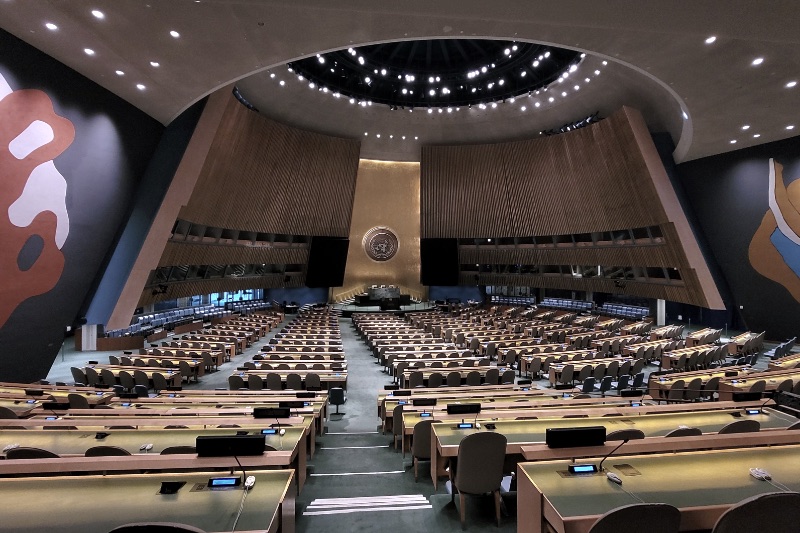
On Tuesday Donald Trump will speak third in the General Assembly hall, after the secretary-general and the president of Brazil. On Wednesday the president of Iran is expected at the same rostrum, nearly seven months after the United States and Israel began their war on his country. On Thursday morning the president of the State of Palestine will address the hall from a screen, because the United States would not let him into New York.
The last two decisions were announced within days of each other by the same government. They look inconsistent. They are not, and the reason is a document nobody will quote from the rostrum this week: the agreement, signed on 26 June 1947, under which the United Nations lives in Manhattan.
What the agreement promises
Section 11 of the Headquarters Agreement says that American authorities “shall not impose any impediments to transit to or from the headquarters district” of the representatives of member states. Section 13 says American entry law is not to be applied so as to interfere with that privilege, and that visas are to be granted without charge and as promptly as possible.
Section 12 is the clause that explains Wednesday. The obligation applies, it says, “irrespective of the relations existing between the Governments of the persons referred to in that section and the Government of the United States.”
The drafters were writing two years after one world war and at the start of a cold one. They understood that an organisation built to manage conflict is useless if its host can keep its enemies away. A war is not an exception to the clause. It is the case the clause was written for.
The State Department's own wording concedes as much. “Consistent with our host country obligations,” it said last week, “the core delegation from the Iranian regime will be able to attend.” Masoud Pezeshkian will be, Reuters reported, the highest-ranking Iranian official to enter the United States since the war began.
What the host keeps
The agreement has a second text, and it is American. When Congress approved the arrangement in 1947 it attached a reservation, Section 6 of Public Law 80-357: nothing in the agreement would weaken “the right of the United States to safeguard its own security and completely to control the entrance of aliens into any territory of the United States other than the headquarters district and its immediate vicinity,” along with the routes needed to reach it.
Read closely, the reservation is narrower than it sounds. It keeps American control over every part of the country except the part the treaty concerns. Its practical use is the one on display this week: a host that cannot easily refuse the journey regulates the traveller instead.
The Iranian delegation is smaller than last year's. According to NPR, not everyone was given a visa, and those admitted face strict limits on where they may go and what they may buy, enforced by diplomatic security agents. Iranian state media said the refusals included the president's communications team and called them “an unprecedented hostile move.” A department spokesman, Tommy Pigott, said the administration would not let the regime's elites “exploit UNGA for a luxury retail splurge.”
None of that stops Pezeshkian from speaking. All of it reminds him whose city he is speaking in.
The case the agreement does not settle
Mahmoud Abbas is the harder case, and the United States has now made it twice. For the second year running, his visa and his delegation's were refused. The American explanation to the Assembly was that the Palestinian Authority and the Palestine Liberation Organization are not complying with their commitments under the Oslo Accords. Tammy Bruce, the deputy American ambassador, said that if the Authority wanted to be treated as a partner it “must stop subsidizing terror and stop using diplomatic theater as a substitute for serious governance.”
Those are reasons of foreign policy, not a security finding about a man travelling to First Avenue. Riyad Mansour, the Palestinian observer, called the refusal “a clear violation” of the host country's obligations. On 17 September the Assembly voted to let Abbas send a pre-recorded statement instead, by 152 votes to three, with only the United States, Israel and Paraguay against.
This has happened before, and the precedent is instructive for what it failed to produce. In November 1988 Secretary of State George Shultz refused Yasser Arafat a visa. The Assembly condemned the decision and moved itself to Geneva for three days in December so that Arafat could speak.
That same year the International Court of Justice, asked about an American law closing the PLO's observer mission in New York, advised unanimously that the United States was obliged to go to arbitration under Section 21 of the agreement. That section provides for a tribunal of three: one arbitrator named by the secretary-general, one by the secretary of state, and a third chosen by the two.
An advisory opinion binds no one, and a tribunal needs the host to name its member. The Assembly's remedy in 1988 was to leave New York. Its remedy now is a video file. Each is a workaround, and each leaves the host's reading of the agreement untested.
Where the power sits
That is the lesson of this week, for anyone looking for one. The United Nations has many rooms in which the United States is one vote among 193. The door is not one of them. It is the single institution of the organisation that the host operates alone, and its only check is a tribunal that cannot sit without an arbitrator the host appoints.
The week is full of reminders of the same arrangement. The Security Council has held three straw polls on a successor to António Guterres, whose term ends with the year, without agreement. The State Department's only public criterion is that the next secretary-general “must get the U.N. back to basics and publicly commit to the changes we require,” and as a permanent member it can veto any candidate who will not.
Xi Jinping will be at the White House on Thursday rather than in the hall. Richard Gowan of the International Crisis Group told NPR the contrast, with smaller countries giving speeches “in a pretty empty General Assembly hall,” could “send a bit of a message about where power really lies.”
Iran, for its part, warned on Sunday that any new American attack would bring sustained retaliation, even as it says it has passed conditions for reopening the Strait of Hormuz to Washington through Qatar. Its president will make that case in New York on Wednesday. That he can make it there is the Headquarters Agreement working as written.
That Abbas cannot is the agreement working as its host prefers to read it. The difference between the two is not in the text. It is settled each September in a single government's consular decisions, and the Assembly's answer is to press play.
Further reading
- Headquarters Agreement between the United Nations and the United States, 1947United Nations Treaty Collection
- General Assembly adopts resolution allowing State of Palestine to participate virtually in high-level debateUnited Nations
- Applicability of the Obligation to Arbitrate under Section 21 of the Headquarters Agreement, advisory opinion of 26 April 1988International Court of Justice
- The U.S. should adhere to its commitments under the U.N. Headquarters AgreementNew York City Bar Association
Nadia Belkacem writes for The 13th Bell on world. This piece was edited and fact checked before publication.
Get The 13th Bell in your inbox