The Finality of an Application
The Air Force asked Guam to renew its permit to detonate munitions on Tarague Beach in 2021. On Wednesday the Supreme Court hears argument on whether sending that application was a decision a court can review.

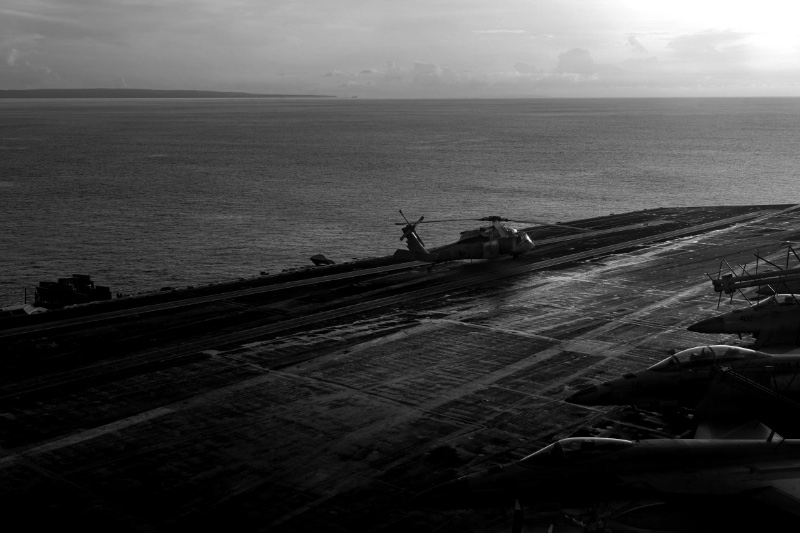
U.S. Air Force photo by Master Sgt. Val Gempis — Public domain, via Wikimedia Commons
On Wednesday the Supreme Court hears a case about a beach on the northern coast of Guam where the Air Force blows up old munitions. The question the justices will take up first is not really about the beach. It is whether a federal agency, by sending a permit-renewal application to a territorial regulator, has taken “final agency action” that a court can review now under the Administrative Procedure Act. The question presented in Department of the Air Force v. Prutehi Guåhan, No. 25-579, puts it in exactly those terms.
The facts are not much in dispute. Since 1982 the Air Force has held a permit under the Resource Conservation and Recovery Act, the federal hazardous-waste law, to treat waste explosives at Andersen Air Force Base by open burning and open detonation. The Guam Environmental Protection Agency runs the permit programme on the island and makes permittees reapply every three years. In May 2021 the Air Force filed a renewal application of more than 350 pages asking for a permit “almost identical” to the one it held, according to the Solicitor General’s brief. Guam EPA published a draft permit, took comments for 45 days and held a public hearing, and in October 2021 told the Air Force it had not reached a final decision. Both sides’ briefs say it still has not. The respondents’ brief says the Air Force suspended open burning in the 2000s but still detonates munitions on Tarague Beach, about 50 yards from the Pacific; the Ninth Circuit’s opinion notes that the beach sits above an aquifer that supplies “more than eighty percent of Guam’s population with drinking water.”
Prutehi Guåhan, a Guam nonprofit then called Prutehi Litekyan: Save Ritidian and represented by Earthjustice, sued in 2022 with one claim: that the decision to submit the 2021 application violated the National Environmental Policy Act, because the Air Force had not first prepared an environmental assessment or impact statement. The District Court of Guam dismissed the suit, holding that the group lacked standing, that the application was not final agency action and, in the alternative, that the hazardous-waste statute’s permit process made NEPA review redundant. On 13 February 2025 a divided Ninth Circuit panel reversed on each point.
Two conditions
The test for finality comes from Bennett v. Spear, decided in 1997. An action is final if it marks “the ‘consummation’ of the agency’s decisionmaking process” and is one by which “‘rights or obligations have been determined,’ or from which ‘legal consequences will flow.’” Judge Marsha Berzon, writing for herself and Judge Eric Miller, held that the Air Force’s decision to apply, and the plans the application described, “reflected the agency’s commitment to a particular location for and method of waste munitions disposal, and so was the endpoint in its decisionmaking process.” Judge Lawrence VanDyke dissented: “submission of an application is a far cry from final agency action.” By creating a rule that would “capture each and every permit application,” he wrote, the decision “turns the prevailing understanding of final agency action on its head.”
The government’s brief follows the dissent. An application, it argues, starts an iterative process in which Guam EPA can demand more information or changes, and filing one is “no more ‘final’ than an agency’s decision to publish a notice of proposed rulemaking.” Any legal consequences will flow from Guam EPA’s eventual decision, not from the Air Force’s request. The respondents answer that the Air Force “has made up its mind to continue OD at Tarague Beach beyond 2021,” and, citing the Court’s 2012 decision in Sackett v. EPA, that the “mere possibility” that an agency might change course “does not suffice to make an otherwise final agency action nonfinal.” (Sackett spoke of an agency reconsidering its own order; the respondents apply the principle to the chance that Guam EPA might say no.)
The permit that did not expire
The most concrete argument on the second condition rests on a single regulation. Under a rule Guam adopted from 40 C.F.R. 270.51, a permit whose holder has filed a timely renewal application does not lapse; its conditions “continue in force” until a new permit takes effect. The 2018 permit would otherwise have expired in 2021. The respondents say the application therefore had a legal effect of its own: it authorised the Air Force to carry out detonations “for an additional five years and counting.” The government’s reply answers that whatever authority exists comes from the old permit: “Unless and until Guam EPA disposes of the Air Force’s request to renew its permit, the relevant rights and obligations are still defined by the 2018 permit, not by the 2021 application.”
Finality also reaches into the merits. In 2023 Congress amended NEPA to say that an agency need not prepare an environmental document if “the proposed agency action is not a final agency action” within the meaning of the APA, 42 U.S.C. 4336(a)(1). The Ninth Circuit applied the older law because the events predate the amendment, but the government’s reply says a ruling against finality “would effectively resolve the merits as well.” The respondents answer, in a footnote to their brief, that the action the Air Force actually proposes is to conduct the detonations, which in their view plainly is final.
The second question
If the Court reaches it, the second question is whether the hazardous-waste statute’s own procedures, which include application requirements, a draft permit, public comment and a hearing on request, displace NEPA. The government relies on the principle that the specific statute governs the general and on an EPA rule from 1980, 40 C.F.R. 124.9(b)(6), which says RCRA permits “are not subject to the environmental impact statement provisions” of NEPA; its brief concedes that Guam’s regulations do not expressly incorporate that rule. The Ninth Circuit held that “the timing of each statute’s prescribed environmental review is entirely distinct,” since NEPA looks at a decision before it is made and the permit review comes after, and that cases letting other statutes stand in for NEPA involved regulators, while the Air Force is not “engaged primarily in an examination of environmental questions.” The respondents point to the 2023 text, which excuses NEPA review where another law excludes the action or where preparing the document “would clearly and fundamentally conflict” with another law, and say neither applies. Among the amici, twenty-one states led by West Virginia and the U.S. Chamber of Commerce, joined by industry groups, filed briefs supporting the Air Force; ten states and the District of Columbia, led by Washington, and four members of Congress filed for the respondents, according to the docket and the briefs’ covers.
What turns on the first answer is timing. If the application is not final, the NEPA claim waits until Guam EPA rules, more than five years after the filing so far, while the 2018 permit stays in force. “So the question is not whether a court ever hears respondent’s NEPA claim,” the respondents write, “but when.” The group’s executive director, Monaeka Flores, told the Pacific Daily News that the outcome “will impact every single community that needs to respond to a federal project.”
Sources
Read on supremecourt.gov: the docket, the question presented, the petition for certiorari, the brief in opposition, the government’s merits brief and reply, and the respondents’ merits brief. The Ninth Circuit’s opinion and Judge VanDyke’s dissent (No. 22-16613) were read on the court’s website; the district court’s order was not read and is described as the briefs and the Ninth Circuit describe it. The text of 42 U.S.C. 4336, 40 C.F.R. 270.51 and 40 C.F.R. 124.9 was read on the Legal Information Institute’s site. The history of the permit, the 2021 application and Guam EPA’s handling of it are as the government’s brief describes them; the description of current operations at Tarague Beach is the respondents’. The amicus briefs were not read beyond their covers, which state the side each supports. The passages quoted from Bennett v. Spear and Sackett v. EPA were checked against the Court’s opinions (Bennett in the United States Reports via the Library of Congress; Sackett on the Legal Information Institute’s site). The quotation from Monaeka Flores is from the Pacific Daily News of 28 September.
Further reading
- Department of the Air Force v. Prutehi Guahan, No. 25-579: Questions PresentedSupreme Court of the United States
- Brief for the Petitioners (Department of the Air Force)Office of the Solicitor General, via supremecourt.gov
- Brief of Respondent Prutehi GuahanEarthjustice, via supremecourt.gov
- Reply Brief for the PetitionersOffice of the Solicitor General, via supremecourt.gov
- Prutehi Litekyan: Save Ritidian v. U.S. Department of the Air Force, No. 22-16613 (opinion and dissent)U.S. Court of Appeals for the Ninth Circuit
- 42 U.S.C. 4336: Procedure for determination of level of reviewLegal Information Institute
- 40 C.F.R. 270.51: Continuation of expiring permitsLegal Information Institute
Gregor Vance writes for The 13th Bell on security. This piece was edited and fact checked before publication.
Get The 13th Bell in your inbox