One Vote Over Three-Fifths
Albania’s parliament cut the number of municipalities from 61 to 46 early on Friday. The constitution requires three-fifths of all 140 members for that law. It passed with 85 votes, one more than the minimum.

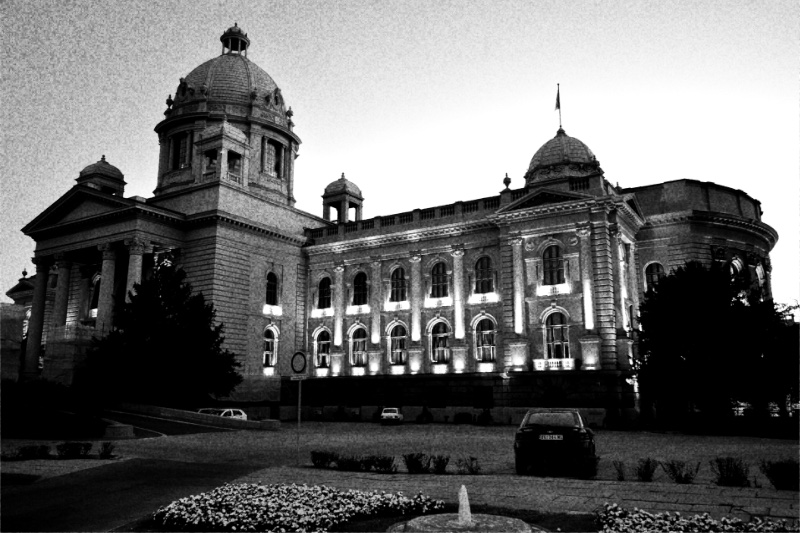
Pasztilla aka Attila Terbócs — CC BY-SA 4.0, via Wikimedia Commons
Albania’s parliament approved the country’s new territorial reform in the early hours of Friday 9 October, after a marathon session marked by heated exchanges inside the chamber and protests outside it, Albanian Daily News reported. Eighty-five deputies voted in favour. The law reorganises local government and reduces the number of municipalities from 61 to 46, and the next local elections are expected to take place under the new map.
Eighty-five is a specific number here. Article 81 of Albania’s constitution lists the laws that must be approved by three-fifths of all members of the Assembly, and the last item on the list is “the law on administrative divisions of the Republic”. Article 64 fixes the Assembly at 140 deputies. Three-fifths of 140 is 84. The reform cleared the line by one vote.
Where the 85 came from
The Socialist Party’s parliamentary group has 82 seats, the Albanian news site Balkanweb reported, and the three seats of the Social Democratic Party completed the qualified majority. Balkanweb read Prime Minister Edi Rama’s effort to reach 85, rather than 84, as a sign that he feared some votes might leak. It reported that none did.
Two Socialists who had objected to the draft, Erion Braçe and Elisa Spiropali, voted with the majority, according to Balkanweb. Braçe’s objection had been public. Speaking in parliament before the vote, he said the draft did not deliver a genuine transfer of power to local government, Albanian Daily News reported, and he answered Rama’s warning that he could be removed from the Socialist parliamentary group if he voted against it. “Being told to vote the way the majority does is not democracy,” Braçe said. Albeu reported that another Socialist, Vullnet Sinaj, who had opposed the draft alongside Braçe at a meeting of the parliamentary group, had earlier signalled a change of position.
Belinda Balluku, Rama’s former deputy, arrived in the chamber for the vote after several weeks of absence, Balkanweb reported. The site said she is under investigation by SPAK, the special prosecution office, on allegations of corruption and money laundering, and that her presence served the majority’s arithmetic. Democratic Party deputies threw water and objects towards her and towards Rama, it reported.
Rama wrote on social media afterwards that the vote had given Albania another step toward modernisation, and that it had shown that no one should count their chickens before they hatch with the Socialist Party, according to Albeu’s English translation of his post.
The opinion of the inhabitants
Article 108 of the constitution says the territorial-administrative division of local government is established by law, and adds: “Their borders may not be changed without first taking the opinion of the inhabitants.” The article does not say what form that opinion must take or what weight it must be given.
The opinion was not hard to find. Fifteen municipalities lose their status under the reform, directly affecting at least 225,000 people, Tirana Times reported before the vote. Residents of Memaliaj travelled about 180 kilometres to protest outside parliament on 2 October against a merger with Tepelenë. In Divjakë, protests against a merger with Lushnjë continued for 51 consecutive days. In Poliçan, where residents objected to joining Berat, the local Socialist Party chair resigned publicly. The commission that prepared the reform worked for nine months and ended without a joint proposal from the majority and the opposition, and the opposition described the continuation of the process as unilateral, the paper reported.
Agron Haxhimali, head of the Institute for the Municipalities of Albania, told Tirana Times that size is not the same thing as self-government. “A larger municipality is not necessarily a more autonomous municipality,” he said. Imeldi Sokoli, a member of the Shkodër municipal council, argued that the draft changes municipal boundaries without substantially changing the functions and powers of local government.
What comes next
The Democratic Party leader, Sali Berisha, said after the vote that his party would continue every legal battle against what he called the execution of 15 municipalities, and that it had begun collecting the signatures needed for a referendum, the public broadcaster RTSH reported. He said the party would study both local and national referendums.
The constitution sets out that route. Article 150 gives 50,000 voters the right to a referendum to abrogate a law. Article 152 requires the Constitutional Court first to review the constitutionality of the question put, within 60 days, after which the President sets the date.
For now the arithmetic is the whole of the result. The law needed 84 votes and received 85, and the two Socialists who had objected to it were among them.
Sources
The time of the vote, the 85 votes, the reduction from 61 to 46 municipalities and the expectation that the next local elections will use the new map are from Albanian Daily News, which also reported Braçe’s remarks in parliament. The Socialist and Social Democratic seat counts, the votes of Braçe and Spiropali, Balluku’s arrival and the investigation, and the protest in the chamber are from Balkanweb, paraphrased from the Albanian original. Rama’s post and Sinaj’s change of position are from Albeu. The number of municipalities affected, the population figure, the local protests, the commission and the remarks of Haxhimali and Sokoli are from Tirana Times. Berisha’s statement is from RTSH, paraphrased from the Albanian. The text of Articles 64, 81, 108, 150 and 152 is from the English translation of the constitution published by the Constitute Project. The calculation of three-fifths of 140 is this publication’s.
Further reading
- Albania’s Parliament Approves Territorial Reform After Marathon SessionAlbanian Daily News
- 85 vota për Territorialen (in Albanian)Balkanweb
- Who Loses Power When the Map Changes?Tirana Times
- Approval of the territorial reform: Rama respondsAlbeu
- Reforma territoriale: Berisha (in Albanian)RTSH
- Albania’s Constitution of 1998 with Amendments through 2016Constitute Project
Owen Blackwood writes for The 13th Bell on legislatures and procedure. This piece was edited and fact checked before publication.
Get The 13th Bell in your inbox