The Ballot Is a Design Problem
How a ballot is laid out changes how it is filled in. That is a documented engineering question, and it is answered mostly by local custom.

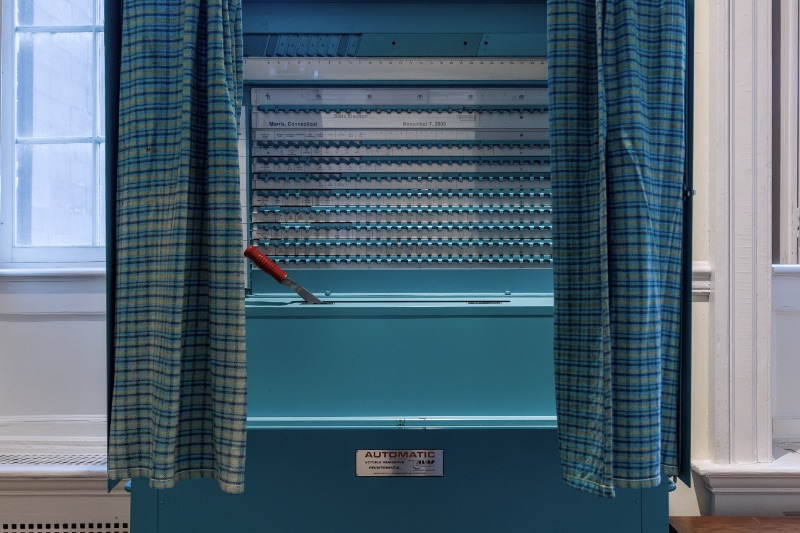
Computer Election Systems, Inc. via Smithsonian — CC0, via Wikimedia Commons
A ballot is an interface. It has to be understood under time pressure, once, by every adult in a jurisdiction regardless of education, eyesight or first language, with no training and no opportunity to correct a mistake once it is submitted.
Almost no other interface is held to that standard, and almost no other interface is designed with as little professional input. Layout decisions are frequently made by county officials working within a statutory template and a printing budget.
The consequences are measurable, which is what separates this from a matter of taste. Instructions that appear after the response they govern get followed less. Candidates placed across a fold get selected less. A contest below a long list gets skipped more often than the same contest at the top.
These are properties of the artefact, not of the electorate. A voter who misses a contest because it sat under a fold has not failed to participate.
There is a body of work on this, and it is not obscure. Federal voting system guidelines address usability and accessibility explicitly, and the standards work behind them treats the ballot as a human factors problem with testable properties.
The gap is between that work and its adoption. Guidelines apply to certified systems. They do not reach the layout choices a county makes within a system, which is where many of the decisions that matter are taken.
The statutory template is often the binding constraint, and it is rarely written with usability in mind. Ordering rules, rotation requirements, font and language mandates, and the election code provisions on what must appear all shape a layout before anyone considers whether it can be read.
Each of those rules answers a legitimate concern about fairness. Together they can produce a document that defeats the voter the fairness was for.
The remedies here are unusually well understood, which is the frustrating part. Test ballots with actual voters before printing them. Publish the designs in advance. Adopt plain-language instruction wording that has been tested rather than drafted by counsel.
None of that is expensive relative to the cost of running an election, and election administrators have material available to do it. What is missing is any requirement that it be done, and any consequence when it is not.
It is worth being precise about the claim. Ballot design does not usually decide an election, and treating every design flaw as a scandal is its own distortion.
The claim is narrower and harder to dismiss: a measurable number of people each cycle intend one thing and record another, for reasons that are known, documented and fixable, and the fixing is left to whoever happens to be laying out the page.
The remedy is unglamorous and well established: test the layout with actual voters before it is printed, the way any other interface would be tested.
Very few jurisdictions do, because the ballot is treated as a legal document rather than as a piece of equipment people have to operate correctly under time pressure.
A legal document is checked for accuracy of content. An interface is checked for whether people can use it, and only the second test catches the failures that change results.
The gap between those two ideas of correctness is where most preventable ballot error still lives.
Cost is the reason usually given for not testing, and it does not survive contact with the numbers.
Usability testing a layout costs a fraction of a single recount, and a jurisdiction that has budgeted for litigation has already accepted the larger expense.
Further reading
- Voluntary Voting System GuidelinesU.S. Election Assistance Commission
- Voting researchNational Institute of Standards and Technology
- California Elections CodeCalifornia Legislative Information
Owen Blackwood writes for The 13th Bell on politics. This piece was edited and fact checked before publication.
Get The 13th Bell in your inbox