A Privilege, and a Paper Trail
The Justice Department told a federal court that White House access is a privilege, not a right. Four days after banning three newsrooms it also sent them the notice, the reasons and the deadline that a right would require.

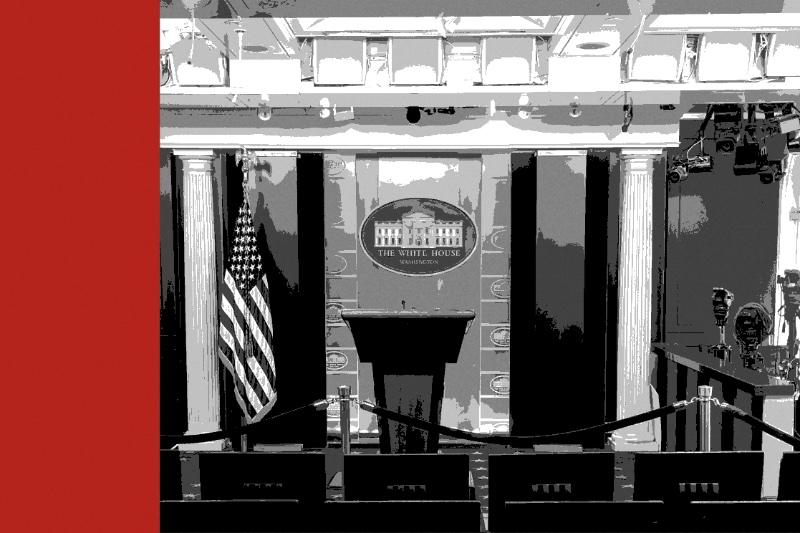
At half past three this afternoon, by videoconference, a federal judge in Washington takes up a question the White House has spent five days insisting is not a question. The case is Cable News Network, Inc. v. Trump, No. 1:26-cv-3287, filed on Monday in the District of Columbia and assigned to Judge Timothy J. Kelly. The plaintiffs are CNN, MS NOW and Politico, with three reporters whose credentials were taken at the gates; they want a temporary restraining order putting the passes back.
The government’s answer, filed on Tuesday, contains the sentence the administration has repeated all week and has now committed to a brief: “access to the White House is a privilege—not a right.”
Read the other eighteen pages and that sentence changes.
The procedure that did not exist on Saturday
On Tuesday, four days after the ban was announced on Truth Social and three days after the hard passes were switched off, the White House sent each organisation a letter. The letters give “notice that the President has made the determination to revoke hard passes for members of your organization.” They state a standard: the “standards of professionalism and decorum expected of those given access to the White House Complex.” They allege a breach of it, “by trafficking in verifiable falsehoods about national security and other issues, and publishing sensitive or classified information.”
Then they get specific, in a “non-exhaustive list of reporting incidents.” CNN, the letter says, disclosed “top-secret” construction details related to the East Wing bunker. MS NOW “reported on an alleged leak investigation.” Politico “published a document detailing funding for the White House ballroom” that described planned Secret Service security work. Each organisation may contest “this initial decision or the factual basis set forth” by five o’clock on Friday. Otherwise, the letters say, “this initial decision will be final.”
Notice of the factual basis. An opportunity to rebut it. A written decision setting out reasons. That is the list this magazine set out on Saturday, drawn from the 1977 case the doctrine rests on. On Saturday none of it existed. It exists now, dated four days late and produced under a filing deadline rather than before a gate.
A government that genuinely believed it was withdrawing a privilege would have had no reason to build any of it.
Arguing against the precedent you are relying on
The brief runs two arguments that cannot both be addressed to the same court. On the First Amendment: “While Defendants acknowledge the D.C. Circuit’s decision in Sherrill, that case was wrongly decided, and Defendants expressly reserve their right to argue so on appeal.” On due process, the same move. Between them sits the alternative case: that the exclusion satisfies Sherrill v. Knight anyway, because the President has two “compelling” reasons — enforcing minimum professional standards among journalists, and protecting classified information.
A district judge cannot overrule his own circuit. The first argument is therefore not addressed to Judge Kelly at all; it is addressed over him, to the D.C. Circuit. The second is the one he will decide. The government has already written its appeal, and is arguing today in the alternative.
What the Associated Press case is being asked to carry
The doctrinal fight is less about Sherrill’s checklist than about what Associated Press v. Budowich now means. In June 2025 a D.C. Circuit panel stayed an injunction that had stopped the White House excluding the AP, on viewpoint grounds, from the Oval Office, Air Force One and Mar-a-Lago. The reasoning was spatial: those places are so tightly controlled and so selective that they are not even nonpublic fora, and so “the White House therefore retains discretion to determine, including on the basis of viewpoint, which journalists will be admitted.”
The Justice Department now argues that “the reasoning of AP should properly control as to all parts of the White House complex,” and the reason it gives repays attention. There are, it says, “a finite number of hard passes,” and the briefing room and West Wing “can accommodate only so many reporters,” which “counsels against the conclusion that the White House is a nonpublic forum.” Scarcity, on this view, licenses selection — which means the more selective access becomes, the freer the government is to select on viewpoint, and every exclusion makes the next one easier to defend.
What a ruling would settle
Three things, in ascending order of durability. The first is whether a hard pass is still a liberty interest. Sherrill held that the interest of a bona fide Washington correspondent in a White House pass “qualifies as liberty which may not be denied without due process of law,” and Karem v. Trump repeated it in 2020. The government routes around the holding rather than denying it: even if the interest exists, post-deprivation process is enough in “extraordinary situations.” The newsrooms answer with the older rule, that the root requirement is a hearing before the deprivation, and with a line the Supreme Court used against this President earlier this year: “that will not do.”
The second is whether the whole complex — driveway, briefing room, lawn positions — is a forum at all, or whether the AP stay swallows the grounds along with the Oval Office.
The third is what “national security” has to consist of before a court will stop looking. The brief leans on an April ruling that upheld a Pentagon press-access policy, and asks the court not to “lightly override” executive judgments. But notice what the three cited stories have in common. None is alleged to have been classified at the moment of publication. The letters describe “sensitive or classified information” and “misinformation about national security information” together, and locate the harm partly in the work of finding out which it was: officials “must evaluate whether the leaked information is classified.” If the cost of checking a story is itself the injury, the category has no floor.
The remedy is staked out too: no injunction may run against the President personally, and any order, the government asks, should be stayed pending an appeal “authorized by the Solicitor General.” Whatever Judge Kelly does at half past three, the letters are now the record, and the deadline in them is Friday at five. The administration has produced, under its own signature, the document it spent five days arguing it did not owe. That is not what a privilege looks like. It is what a right looks like when the government would rather not say so.
Further reading
- CNN, MS NOW and Politico have their day in court against TrumpNPR
- Defending Trump media ban, DOJ cites national security and says White House access is a ‘privilege’NBC News
- CNN, Politico and MS NOW to face off with Trump administration in court over White House banNBC News
- Cable News Network, Inc. v. Trump, No. 1:26-cv-03287 (D.D.C.) — docket and filingsCourtListener
Ruth Okonkwo writes for The 13th Bell on law. This piece was edited and fact checked before publication.
Get The 13th Bell in your inbox