A Mission, Not a Consulate
Israel says Britain’s consulate general in Jerusalem stopped functioning on Thursday and that only seven diplomats may stay. Britain says the building is open and independent under a new name. Each account depends on who has the right to classify the post.

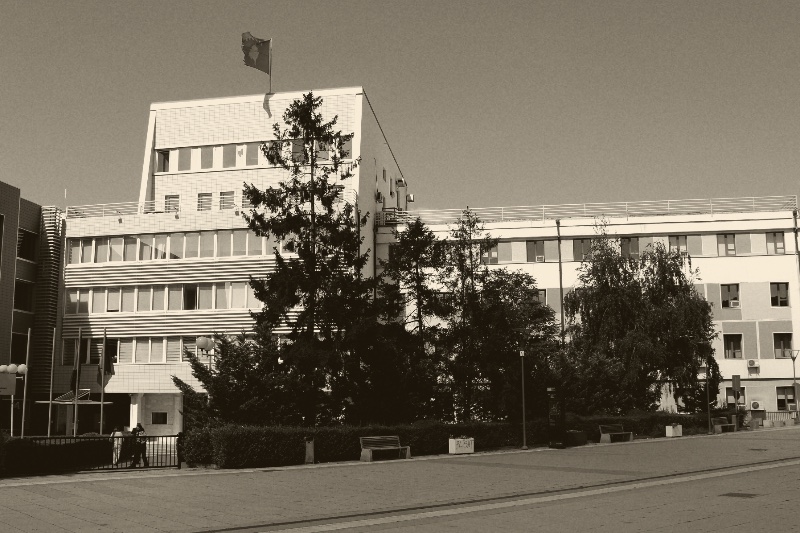
יעקב — CC0, via Wikimedia Commons
On Thursday 8 October, the building in East Jerusalem that Britain has used as its consulate general stopped being called one. Reuters journalists saw workers remove a plaque reading “British Consulate General” from the building, along with a sign for its consular section, Al Jazeera reported. The British flag was still flying. In a statement issued that morning, the Foreign Secretary, Ed Miliband, said that following discussions with Israel, “our Consulate General building will not be closing, and will be known as the UK Mission, Jerusalem from today.”
Israel described the same morning differently. “The British Consulate in Jerusalem ended its role today. The Consul General and 19 diplomats are ending their assignments and will leave Israel,” the Israeli foreign minister, Gideon Sa’ar, said, according to the Jewish Telegraphic Agency. He went on: “We have allowed the British Government to operate a task force of only seven diplomats from the building, which ceased to function as a consulate today. Their scope of activity will be very limited.”
Both accounts describe the same building and the same people. What separates them is a classification, and the classification is the thing the two governments disagree about.
Thirty days
Thursday marked 30 days since Israel ordered the consulate closed, Al Jazeera reported. The order answered Britain’s sanctions on Israeli settlements in the occupied West Bank, including a ban on importing goods produced there. JTA reported that the trade ban could take six months to implement. Sa’ar said the closure was necessary. “It is not possible to act against Israel without Israel taking appropriate measures in response,” he said, according to JTA. “We did not want to reach this point, but the actions of the U.K. Labour Government brought us here.”
Britain had threatened to respond with a mass expulsion of diplomats, The Guardian reported, before the two countries appeared to back away from a full diplomatic dispute. “Without an understanding, we would not have the necessary assurances for the security and protections of our staff and premises,” Miliband’s statement says. The UK has temporarily withdrawn a number of staff and families as a result. “We will work in the coming months to build back up our presence, and we will not take reciprocal action while such discussions are underway and credible,” he said.
What the convention says
The Vienna Convention on Consular Relations of 1963 does not list a mission among its consular posts. Article 1 defines a consular post as any consulate-general, consulate, vice-consulate or consular agency. Article 4 opens: “A consular post may be established in the territory of the receiving State only with that State’s consent.” Its third paragraph deals with changes of classification: “Subsequent changes in the seat of the consular post, its classification or the consular district may be made by the sending State only with the consent of the receiving State.”
Read plainly, that text makes a change of classification something the receiving state must agree to. Israel’s statement treats the post as a consulate that has ended its role. Britain does not accept that Israel has the power to end it. “We have been clear that we do not accept that the Government of Israel has the legal right to close the British Consulate General in Jerusalem, which has been there for nearly 200 years,” Miliband said. “The UK government reiterates its long-standing view that East Jerusalem is occupied territory.”
A building with a new name and no consular plaque lets each government describe Thursday without accepting the other’s premise. Israel can say a consulate closed. Britain can say nothing closed and that it has never accepted Israel’s right to close it. That reading is this publication’s, not either government’s.
Who it reports to
The Guardian reported that the British post in Jerusalem is unlike consulates general elsewhere. It is not a satellite of the embassy in Tel Aviv, and its diplomats are part of an independent team who report directly to London. There are seven other consulates general in East Jerusalem, all opened before 1948, the paper reported, and like the British one they report directly to their foreign ministries. Their status reflects the designation of Jerusalem as a “corpus separatum” under the UN’s 1947 partition plan, which was never implemented.
Israeli forces occupied East Jerusalem in 1967, and the Knesset passed a law annexing the city in 1980, a status most of the world has not recognised, according to The Guardian. The United States had a consulate general in the city but closed it after Donald Trump recognised Jerusalem as Israel’s capital during his first presidency.
That independence is the part Britain kept. “The UK Mission, Jerusalem is independent, operational, and will continue to deliver vital services and our work with the Palestinian people,” Miliband said. Al Jazeera reported that the consulate, in the Sheikh Jarrah neighbourhood, handles Britain’s relations with Palestinians in Jerusalem, the occupied West Bank and Gaza and provides consular services to Palestinians. The closure order does not affect the British embassy in Tel Aviv, which handles relations with Israel’s government.
Daniel Seidemann, an Israeli lawyer and expert on the geopolitics of Jerusalem who has advised western diplomats, told The Guardian the settlement was the least bad of the choices available. “The arrangement that the UK arrived at with Israel was probably the optimal among a number of options that were even worse. So I’m not faulting anybody, but this is far from a victory,” he said.
Seven, for now
The staffing figures so far are Israel’s. Sa’ar put the departures at 20, including the consul general, and the staff allowed to remain at seven. Miliband’s statement gives no numbers. Reporting from London for Al Jazeera, Camille Nedelec said: “We understand that there are dozens of diplomats who are now leaving or have already left.”
The Guardian reported that one source described the compromise as a temporary “ceasefire,” and that if Israel has a new leader after national elections due on 27 October, negotiations on the status of the consulate and its staff could resume. Until then the building in Sheikh Jarrah keeps its flag and its line to London, and has lost its plaque.
Sources
Miliband’s remarks are from his statement published on GOV.UK on 8 October. The removal of the plaque and signs, the 30-day deadline, the reason for the order, the location and role of the consulate, the position of the Tel Aviv embassy and Camille Nedelec’s remarks are as Al Jazeera reported them, drawing on Reuters. Sa’ar’s statements and the six-month implementation estimate are from the Jewish Telegraphic Agency’s report, as published by the Cleveland Jewish News. The threatened expulsions, the post’s reporting line, the other consulates general, the 1947 plan, the 1980 law, the US closure, the election date, the “ceasefire” description and Daniel Seidemann’s remarks are from The Guardian. The text of Articles 1 and 4 is from the United Nations copy of the Vienna Convention on Consular Relations. The reading of Article 4 against Thursday’s change is this publication’s.
Further reading
- Foreign Secretary statement on the UK’s diplomatic presence in JerusalemGOV.UK
- UK renames East Jerusalem consulate as a mission; some diplomats to remainAl Jazeera
- Israel’s downgrading of UK consulate aims to tighten its hold on JerusalemThe Guardian
- British consulate in Jerusalem downgraded, 20 diplomats asked to leaveJewish Telegraphic Agency
- Vienna Convention on Consular RelationsUnited Nations
Nadia Belkacem writes for The 13th Bell on world affairs. This piece was edited and fact checked before publication.
Get The 13th Bell in your inbox