Three Proposals Left
The Riksdag voted down Magdalena Andersson as prime minister by 248 votes to 99, with three parties from her own side of the chamber voting no. The Speaker has three proposals left before Sweden must hold an extra election, and will name his next step on Monday.

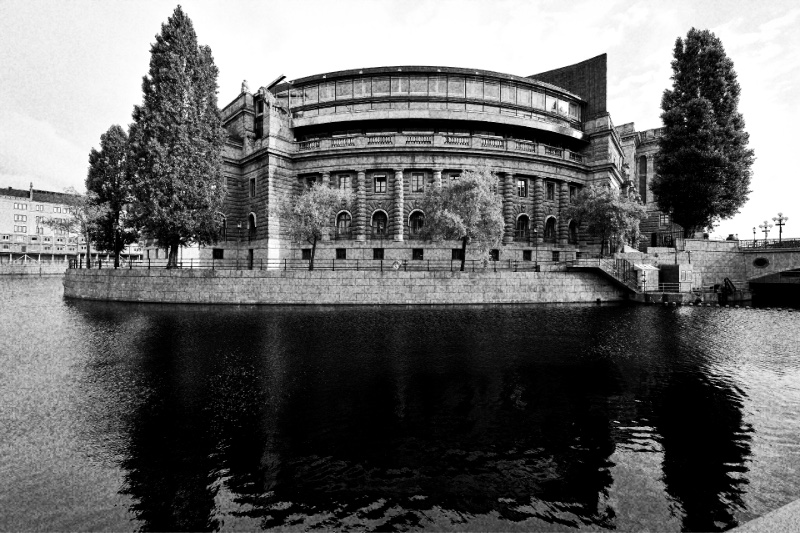
Suyash Dwivedi — CC BY-SA 4.0, via Wikimedia Commons
The Riksdag rejected Magdalena Andersson as Sweden’s prime minister on Thursday 15 October by 248 votes to 99, with no abstentions and two members absent, according to the Riksdag’s record of the vote. It was the first time the Speaker, Andreas Norlén, had put a name to the chamber since the election on 13 September. He may put forward four in all. If none is approved, the Riksdag says, “ska extra val hållas inom tre månader”: an extra election must be held within three months.
On Friday Norlén said he would announce his next step at a press conference at 13:30 on Monday 19 October. Three proposals remain.
How the 248 were made
A Swedish prime minister does not need a majority in favour, only the absence of a majority against. As this publication set out on Monday, a proposal fails only if at least 175 of the 349 members vote no. The four parties that backed the outgoing government, the Moderates, Sweden Democrats, Christian Democrats and Liberals, hold 173 seats. On their own they could not have defeated her.
They did not have to. The Riksdag’s party table shows all 99 Social Democrats voting yes and every other member present voting no: the Moderates 70, the Sweden Democrats 62, the Left 29, the Centre 25, the Christian Democrats 22, the Greens 21 and the Liberals 19. The two absentees were one Left member and one Green. On this publication’s arithmetic, the three parties that sit with the Social Democrats on the opposition side supplied 75 of the 248 no votes. Without them the no votes would have numbered 173, two short of 175, and Andersson would have been approved.
A no from the Left, the Centre and the Greens is not a vote for the right. Andersson’s difficulty, which this publication described on Monday, is that the Centre will not back a government that gives the Left cabinet posts and the Left will not back one that does not. The vote put that disagreement on the record.
How the first proposal was spent
The Riksdag’s notice of Tuesday 13 October records the sequence. Andersson reported to the Speaker on her assignment to explore a government the Riksdag could tolerate. “Vid mitt möte med Magdalena Andersson meddelade hon att hon för närvarande inte ser det som meningsfullt att fortsätta sondera,” Norlén said: at their meeting she told him she did not, for now, see any point in continuing to explore. He then put her forward as his proposal “för en socialdemokratisk enpartiregering,” for a Social Democratic single-party government. The proposal was tabled that day and again on Wednesday, and put to the vote at noon on Thursday.
So the first of the four proposals went on a candidate who had said she saw no route to a government, for a cabinet of one party holding 99 seats. That is the use of a first vote the Speaker had signalled. When he renewed her assignment on 2 October he said it would end with a vote in the Riksdag whether or not she succeeded, SVT reported, and the TT news agency quoted him as saying a vote was needed to move forward and increase pressure on the parties.
Who governs in the meantime
Ulf Kristersson of the Moderates asked to be released as prime minister on 17 September, and the Speaker dismissed him and his ministers. Until a new government takes office, the Riksdag notes, Kristersson remains prime minister of a caretaker government of the Moderates, Christian Democrats and Liberals. If all four proposals fail, it would remain in office until an extra election produced a successor.
What the Speaker said on Friday
Norlén spoke to the party leaders by telephone, according to the Riksdag’s notice published at 11:49 on Friday. “Jag kommer nu att reflektera över den information jag har fått från partiledarna och ha fortsatta diskussioner,” he said: he would now reflect on what the party leaders had told him and hold further discussions. He added that he expected the leaders to use the time well for their own talks, and that “det krävs inte att någon har ett formellt sonderingsuppdrag för att partierna ska kunna ha dialog med varandra”: nobody needs a formal exploratory assignment for the parties to talk to each other.
He did not say whether Monday’s step will be a new exploratory assignment or a second name for the chamber. The first proposal took three days from tabling to vote. Each that follows spends one of the three that remain, and the fourth failure would send Sweden back to the polls.
Further reading
Thomas Rennick writes for The 13th Bell on world. This piece was edited and fact checked before publication.
Get The 13th Bell in your inbox