The Strait Nobody Owns
Hormuz and Bab al-Mandab are narrow enough to sit inside somebody's territorial sea. The law answers that with a right of passage nobody grants and nobody can withdraw, which works until somebody decides it does not.

NASA — Public domain, via Wikimedia Commons
A state's territorial sea extends twelve nautical miles from its coast. Inside it, the state is sovereign, subject to a right of innocent passage that it can suspend temporarily for security.
That rule is workable almost everywhere. It stops working in a strait narrower than twenty-four nautical miles, because there is no water left that belongs to nobody.
The Strait of Hormuz is such a place. So is Bab al-Mandab. So are dozens of other passages that international trade depends on.
The Convention on the Law of the Sea answers this with a separate regime for straits used for international navigation: transit passage.
Transit passage is stronger than innocent passage in two ways that matter. It cannot be suspended, and it covers aircraft and submerged submarines as well as surface ships.
The coastal state keeps its sovereignty over the water. What it loses is the power to decide who may cross it.
In exchange, ships and aircraft in transit must proceed without delay, refrain from any threat or use of force against the coastal state, and comply with generally accepted international regulations on safety and pollution.
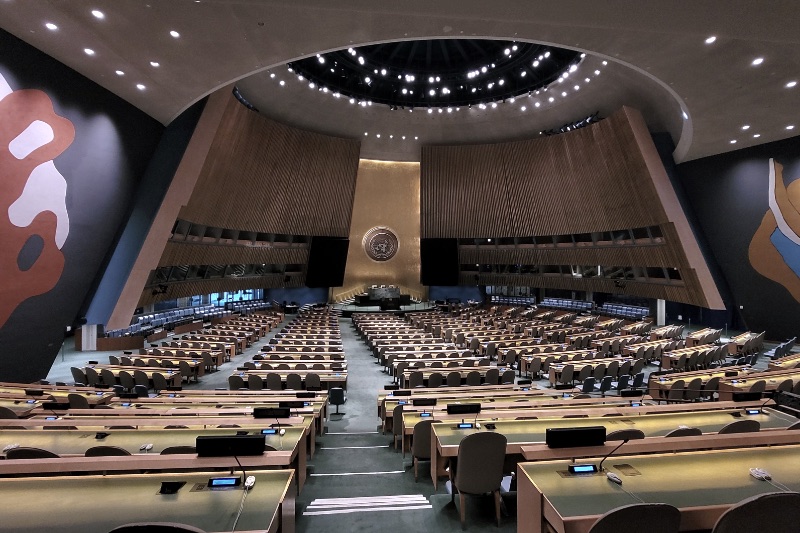
The United Nations' own summary of it describes the bargain plainly: coastal states gained enormous maritime zones under the convention, and the price was guaranteed passage through the straits those zones would otherwise have closed.
That bargain has a structural weakness, and it is visible in the Gulf this year.
The convention creates a right, not an enforcement mechanism. No body is charged with keeping a strait open. When passage is obstructed, the remedies are the ordinary ones of international law: protest, diplomacy, and the naval power of the states whose shipping is affected.
The legal position and the practical position separate at that point. A right of transit passage does not move a tanker whose insurer will not cover the voyage.
The conventions the shipping industry runs on sit alongside the law of the sea and are equally practical in effect. They govern construction standards, crew certification, pollution liability and traffic separation schemes.
Those schemes are the reason a strait works at all in normal times: ships travelling in opposite directions use separate lanes, agreed internationally and enforced by the flag states rather than by the coastal one.
The organisation's safety work is where they are maintained. It is unglamorous, technical and almost never discussed outside the industry, and it is what makes 20 percent of the world's oil moving through a two-lane channel a routine matter.
The convention's other complication is who has signed it. It has been ratified by most states, including every state bordering the Gulf except one, and by the European Union.
The United States has not ratified it. Successive administrations have nonetheless treated the navigation provisions, including transit passage, as customary international law binding on everyone, and the US Navy conducts operations on that basis.
Iran signed the convention but never ratified it, and has argued that transit passage therefore does not bind it, and that only innocent passage — which can be suspended — applies to non-parties in its waters.
That argument has never been accepted by the maritime powers, and for decades it did not matter, because the strait stayed open.
It matters now. A legal regime that depends on nobody testing it is a description of a habit rather than a rule, and the habit in Hormuz has broken.
What would restore it is not a new treaty. It is the same thing that made the old one work: enough states with enough ships deciding that an open strait is worth more than any advantage available from closing it.
Further reading
- United Nations Convention on the Law of the SeaUnited Nations Division for Ocean Affairs and the Law of the Sea
- The United Nations Convention on the Law of the Sea: A Historical PerspectiveUnited Nations
- List of IMO ConventionsInternational Maritime Organization
Iris Nakamura writes for The 13th Bell on world. This piece was edited and fact checked before publication.
Get The 13th Bell in your inbox