The Refugee Ceiling Is One Signature
A number that decides how many people may be admitted in a year is set annually by a single official, after a consultation with no binding effect.

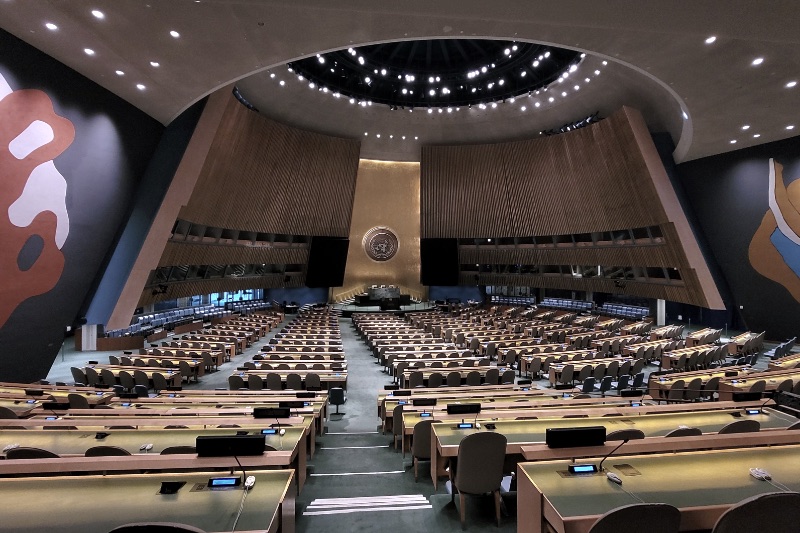
BulbazaurREX — CC0, via Wikimedia Commons
Immigration policy is argued as though it were made by legislation. Bills are introduced, compromises are proposed, and the argument recurs every few years without resolving.
Meanwhile one of the most consequential numbers in the field is set every twelve months by a single official, and setting it requires no legislative action at all.
The provision that creates the ceiling requires consultation before the number is fixed. It does not require agreement, and it does not make the consultation binding.
So the procedure is real and the constraint is not. An official who consults and then sets whatever figure they intended has complied fully with the statute.
The consultation requirement is worth reading closely, because its wording assumes a set of practices rather than compelling them.
The number itself is not a projection or a forecast. It is a cap, and admissions below it are the norm rather than the exception, which makes the ceiling only half the policy.
It assumes the parties want an outcome both can defend, which is a reasonable drafting assumption in a co-operative period and provides no floor in an adversarial one.
The other half is processing capacity, and capacity is set by budgets and staffing that receive none of the attention the headline number attracts.
There is a comparison worth making with the visa categories, which are set numerically in statute and move only when the statute moves.
A high ceiling with no capacity behind it admits fewer people than a lower ceiling with functioning processing, which is the single most misunderstood fact in this area.
Those numbers are widely criticised for being frozen and out of date, and being frozen is also what makes them predictable enough to plan against.
The implementing regulations describe the machinery of eligibility and screening, and the length of that machinery is the practical determinant of how many arrive.
The refugee ceiling has the opposite problem and the opposite virtue, and the choice between the two failure modes has never really been argued in public.
Each stage in the sequence is defensible on its own terms and the cumulative delay is nobody's decision, which is the pattern this publication keeps finding in different fields.
The annual cycle compounds it. A person whose case does not conclude within a year is counted against a subsequent ceiling, so a processing delay becomes a reduction in admissions.
The register publishes the determination each year, and reading a run of them shows how much the figure moves and how little the reasoning changes.
The justification offered is generally the same set of considerations in the same order, which suggests the number is arrived at first and explained afterwards.
That may be unavoidable. There is no formula that could generate the right figure, and pretending otherwise would only disguise a judgement as a calculation.
But a judgement made by one person is a different thing from a judgement made by one person with no obligation to explain it against any stated criterion.
The enacted history shows the arrangement was designed as a compromise: predictable rules for who qualifies, executive discretion for how many.
The compromise assumed the consultation would function as a real check, which it might have in a period when the two branches negotiated routinely.
It does not function that way now, and the statute contains nothing that would make it, because a consultation requirement with no consequence for ignoring it is a formality.
The consequence is a policy that swings sharply with each administration, which is precisely the outcome a statutory scheme is supposed to prevent.
People planning around it — resettlement organisations, local authorities, the applicants themselves — cannot plan on a horizon longer than one year.
Capacity built for a high ceiling is dismantled when the ceiling drops, and cannot be rebuilt quickly when it rises, so the swings damage the system in both directions.
The fix does not require settling the underlying disagreement about numbers. It requires that the figure be set for a multi-year period, or that a departure from the prior year be justified against published criteria.
Either would convert an annual assertion into an argument, which is the minimum a decision of this weight ought to have to survive.
Further reading
- Annual admission of refugees, 8 U.S.C. § 1157Office of the Law Revision Counsel, U.S. House
- Title 8, Aliens and NationalityU.S. Government Publishing Office
- The Federal RegisterU.S. Government Publishing Office
Nadia Belkacem writes for The 13th Bell on world. This piece was edited and fact checked before publication.
Get The 13th Bell in your inbox