A Redistricting Fight Nobody Is Watching
Municipal and county lines get redrawn with almost no scrutiny, and they decide who runs the services people actually touch.

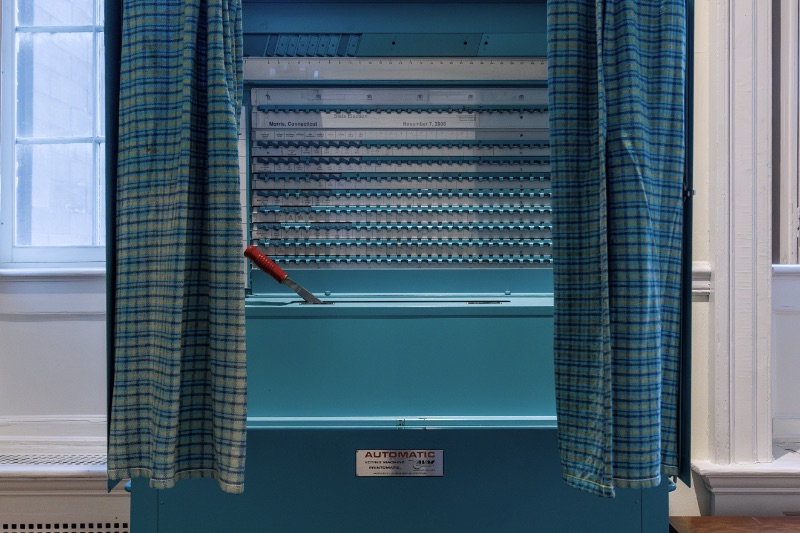
Charles O'Rear — Public domain, via Wikimedia Commons
Congressional maps get litigation, national coverage, and well funded advocacy on both sides. County commission maps get a public notice in a legal advertisement section and a hearing attended by nine people.
The gap is strange, because the local map governs decisions residents encounter directly: which schools get built, where a road project goes, how a sheriff's budget is set, whether a zoning variance clears. A commission drawn to produce a stable majority will produce one for a decade.
The mechanics are also easier to bend at the local level. Fewer seats means each boundary decision carries more weight, and the data required to draw a map to a desired outcome is now cheap and publicly available.
What is missing is not law. Most states impose the same basic requirements at every level. What is missing is anyone watching, which is a resource problem that no statute can fix.
The asymmetry has a simple mechanical cause. A congressional map produces a fight because there is a well funded party on each side of it with a national interest in the outcome. A county commission map has no such constituency.
That absence is not a gap in the law. State election codes generally impose the same core requirements at every level: population equality, contiguity, notice before adoption, and an opportunity to be heard.
The requirements are procedural, and procedure only binds when somebody is prepared to enforce it. A hearing held in an empty room satisfies the statute exactly as well as a hearing held in a full one.
The data question has quietly reversed. The census data everyone draws from is public, standardised and released on a schedule, and the software to draw a map against it costs almost nothing.
That used to be the protection. Drawing a precise map required expertise and money, which limited who could do it. Now the limiting factor is only whether anyone bothers to check the map that was drawn.
Small bodies are also more sensitive to a boundary than large ones. Moving a few thousand residents between districts is a rounding error in a congressional map and can be decisive across five county seats.
Nor is the incentive hidden. The people drawing a local map are frequently the people who will stand in the districts it creates, and there is often no independent body between the two.
The same basic requirements exist in most states precisely because that conflict was foreseen. What was not solved is who reviews compliance when no party has the resources or the interest to litigate.
The consequences are concrete rather than abstract. Local bodies decide where a road goes, which schools are built, how a sheriff's budget is set, and whether a zoning variance is granted, and each of those follows the map.
There is a reasonable objection that local government is small enough to watch informally, through neighbours and word of mouth. That was true when a newspaper attended the meetings and is not obviously true now.
What would help is not new law but a low cost of noticing: publishing proposed maps in a standard machine-readable form, early enough that somebody could run the obvious tests, which election administrators are already equipped to do.
That would not stop a determined majority from drawing the map it wants. It would mean the map had to be defended in public by someone willing to say out loud why it looks the way it does.
It is worth naming the thing that makes this hard to report, because it is not secrecy. Everything here happens in public, on the record, in front of anyone who attends.
That is precisely why it goes uncovered. There is no document to obtain and no source to cultivate, only a meeting that has to be sat through, and the cost of sitting through it is the same whether the map turns out to be ordinary or not.
Owen Blackwood writes for The 13th Bell on politics. This piece was edited and fact checked before publication.
Get The 13th Bell in your inbox