State Department Orders Staff Out of Saudi Arabia While Six Other Embassies Announce Nothing
The Director of National Intelligence has told the Secretary of State that Iranian plots against Americans abroad are at “advanced stages.” The State Department has ordered staff out of one country, and six embassies reported to be cutting staff have announced nothing.

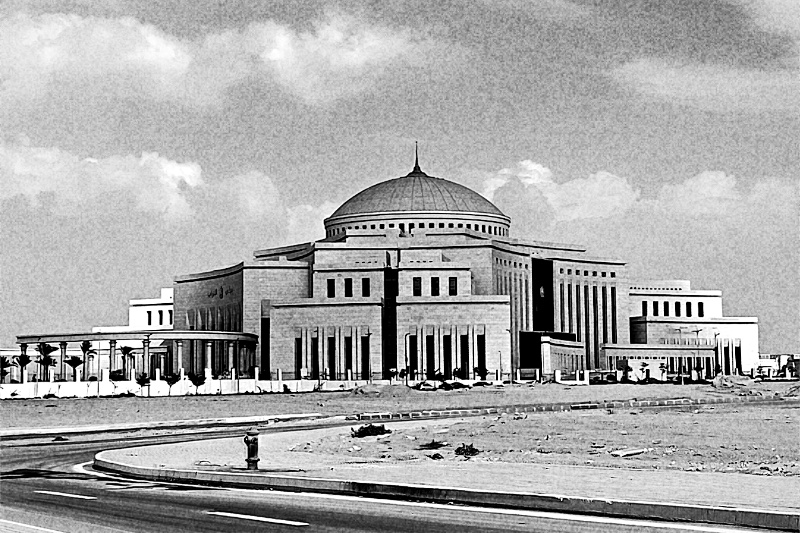
U.S. Embassy in Riyadh — Public domain, via Wikimedia Commons
The State Department has formally ordered staff out of one country in the Middle East, Saudi Arabia, even as the Director of National Intelligence warns that Iranian plots against Americans abroad have reached “advanced stages.” Reductions reported at six other embassies in the region appear in none of those posts’ published notices.
The warning is in an unclassified memo that Director of National Intelligence Jay Clayton sent to Secretary of State Marco Rubio on Friday 23 October, which Axios first reported and Fox News says US officials confirmed as authentic. “Specifically, through various channels, we have received intelligence that Iran has substantially increased efforts to target U.S. personnel,” the memo states, as quoted by Fox. “The lethal plotting efforts by the Iranians against U.S. citizens have reached advanced stages in both the Middle East and certain other countries.” Intelligence officials, it adds, will work to downgrade the classification of some of the underlying intelligence so it can be shared with State Department personnel.
Who decides how many people stay at an embassy?
The State Department, not the intelligence agencies. The department’s own rules in the Foreign Affairs Manual, 3 FAM 3771, set out two steps. An authorized departure is “an evacuation procedure, short of ordered departure,” under which employees and family members “are permitted to leave post”; it is requested by the ambassador and approved by the Under Secretary for Management. An ordered departure is one by which the number of staff and family members at a post “is reduced”, and it “is mandatory and may be initiated by the chief of mission or the Secretary of State.”
A memo from the intelligence community moves no one by itself. It goes to the official who can order a departure, and its stated purpose, getting more intelligence into the hands of State Department staff, points at that decision. A US official told Fox News: “When it comes to our staffing at embassies, we constantly evaluate new information about the security environment.” The official added that “the threat of Houthi attacks and of Iranian terror plots targeting U.S. officials are informing our decisions on staffing adjustments for embassies on RO Status in the region,” the department’s shorthand for reduced operations.
What has actually been ordered?
One departure. The US Mission to Saudi Arabia’s security alert of 25 October says that “effective October 23, 2026, the Department of State ordered non-emergency U.S. government employees and U.S. government employee family members to leave Saudi Arabia due to safety risks.” It cites Houthi attacks “on civilian airports and other critical infrastructure” and says Riyadh’s King Khalid International Airport announced a partial reopening that day. Press reports dated the announcement to Wednesday 21 October. After reports that staff were being withdrawn from the whole Gulf, department spokesman Tommy Pigott called claims of a broader regional shutdown “inaccurate,” Fox reported.
The rest is less visible. CNN has reported quieter staff reductions at the embassies in the United Arab Emirates, Bahrain, Kuwait, Qatar, Jordan and Lebanon, Al Jazeera reports. None of those six posts’ websites, checked by this publication on 25 October, announces an authorized or ordered departure. Their most recent security alerts, issued between 18 and 24 October, all warn that “Iran and groups supportive of Iran may target other U.S. interests overseas”, and those for Bahrain, Qatar, Jordan and Lebanon describe the embassy as open. The Beirut alert of 24 October says the embassy is open “for limited routine and emergency American citizens and visa services.”
| Post | Published departure status, 25 October | Travel advisory shown |
|---|---|---|
| Saudi Arabia | Ordered departure, effective 23 October | Level 3 |
| United Arab Emirates | None published | Level 3 |
| Bahrain | None published | Level 3 |
| Kuwait | None published | Level 3 |
| Qatar | None published | Level 3 |
| Jordan | None published | Level 3 |
| Lebanon | None published | Level 4 |
The table records what each embassy’s own website showed on 25 October; the advisory level is the banner each site displayed. It does not show staffing. This publication has not been able to confirm how, or under which of the two procedures, if either, the reported reductions were made.
How serious is the threat assessment?
Serious enough to put in writing to the Secretary of State, but its basis is not public. The memo itself has not been released, and this account rests on Fox’s quotation of it. Iran has not responded to the memo, Al Jazeera reports. The background is the war that began on 28 February: the Pentagon has confirmed 21 US military personnel killed in the Middle East since then, according to Al Jazeera, and on Wednesday a spokesman for Iran’s Islamic Revolutionary Guard Corps, Hossein Mohebbi, said Tehran would adopt a new “offensive” strategy if the United States renewed its attacks. President Trump said on Friday that the US “may do another little epic fury,” using the code name for the February campaign.
The threat is not limited to the Gulf. On 23 October the embassy in Amman reported an attack that day on a Greek Orthodox church in Karak, in which Jordan’s Public Security Directorate counted seven dead; the alert attributes it to no one, and nothing published links it to Iran.
What is still unknown?
Most of what would let an outsider judge the response: staffing levels at the six posts, the memo’s full text, and whether any embassy beyond Riyadh is under an authorized departure that has not been announced. The paper record for this crisis is one ordered departure, dated 23 October, and one memo that has been quoted but not released.
Further reading
- Security Alert: U.S. Mission to Saudi Arabia, October 25, 2026U.S. Mission to Saudi Arabia
- 3 FAM 3770: Travel to posts under authorized departure, ordered departure and other operating statusesU.S. Department of State, Foreign Affairs Manual
- Security Alert: U.S. Embassy Beirut, October 24, 2026U.S. Embassy Beirut
- Security Alert: U.S. Embassy Amman, October 23, 2026U.S. Embassy Amman
- Iran has ‘substantially increased’ efforts to target Americans abroad, US intelligence memo warnsFox News
- Is Iran planning attacks on Americans; why is the US on alert?Al Jazeera
Nadia Belkacem is a house byline used by The 13th Bell’s World desk. This piece was checked against the sources listed below before an editor approved it. See How we use AI.
Get The 13th Bell in your inbox