The Notice Is the Veto Window
Major arms sales must be notified to the legislature before they proceed. The window that follows has never once been used to stop one.

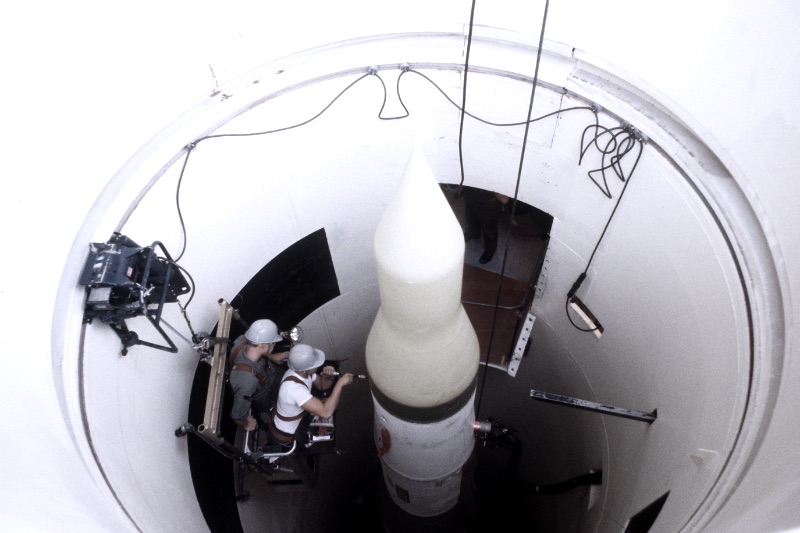
Ken Bergmann — Public domain, via Wikimedia Commons
Selling weapons to another state is among the most consequential things a government does short of using them itself, and it is done by executive decision.
The notification requirement is the check on that. Above a threshold, a proposed sale must be reported to the legislature, which then has a fixed period to object.
The design is sound. It does not require approval, which would make every sale a political event, but it creates a window in which objection is possible.
The window has never been used to stop a sale. Resolutions of disapproval have been introduced, some have passed a chamber, and none has completed the course against a veto.
That record is usually read as evidence the check is toothless. The more accurate reading is that it operates before the notice is ever sent.
There is a category question underneath all of this that the threshold approach handles badly.
An executive that expects a fight consults informally first, and a sale that would draw one is adjusted or delayed at that stage, where nothing is recorded.
A large sale of unremarkable equipment triggers notification while a small transfer of something genuinely sensitive may not, because the test is price rather than capability.
So the mechanism does constrain, and it constrains in a way that leaves no trace, which makes it impossible to assess from the outside.
Capability is harder to define and would require judgement, which is presumably why a number was chosen, and a number is exactly what inflation erodes.
The enacted framework sets the thresholds, and the thresholds are the part that has aged least well.
The result is a filter that has drifted away from what it was meant to catch, in a field where the consequences of missing something are not recoverable.
They are nominal figures set decades ago and not indexed, so inflation has steadily lowered the real value of a sale that triggers notification.
That should mean more scrutiny over time, and in practice it means more notifications of routine transactions, which is a reliable way to exhaust attention.
A committee receiving a continuous stream of notices treats them as administrative traffic, which is exactly what a body being asked to review everything ends up doing.
The emergency provision is the sharper issue. Certification that an emergency exists allows a sale to proceed without the waiting period.
The provision is necessary, since a genuine crisis will not wait, and it is written broadly enough that the determination is effectively unreviewable.
Used sparingly it is a safety valve. Used to move a package that would have drawn an objection, it converts the whole scheme into a formality, and nothing in the text distinguishes the two.
The published decisions contain very little on any of this, because a legislature that has not exhausted its own remedies has a weak claim to bring.
The courts are right to stay out. A body that can pass a resolution and does not has not been deprived of anything a court could restore.
Which puts the whole weight on the legislature's willingness to act, and that willingness has been consistently lower than the rhetoric around individual sales suggests.
The budget documents record the financing side, where a substantial share of these transfers is underwritten by the seller's own assistance programmes.
A sale funded by grant assistance is not really a sale. It is a transfer with an invoice attached, and it is notified under the same procedure as a commercial transaction.
The reform that would matter is not a stronger veto, which the legislature already has and does not use. It is indexing the thresholds and narrowing the emergency certification to a stated set of conditions.
That would restore the scheme to what it was built to be: a small number of significant decisions, examined properly, instead of a continuous stream nobody has the capacity to read.
Further reading
- Reports and certifications to Congress, 22 U.S.C. § 2776Office of the Law Revision Counsel, U.S. House
- United States Statutes at LargeU.S. Government Publishing Office
- Budget of the United States GovernmentU.S. Government Publishing Office
Gregor Vance writes for The 13th Bell on security. This piece was edited and fact checked before publication.
Get The 13th Bell in your inbox