A Fine Needs a Finding
A federal judge in Boston has stayed the rule DHS used to fine migrants up to $1.8 million for failing to leave. The departments have now finalised it with one change, due in the Federal Register on Wednesday, and the court’s question was never whether the statute allows fines.

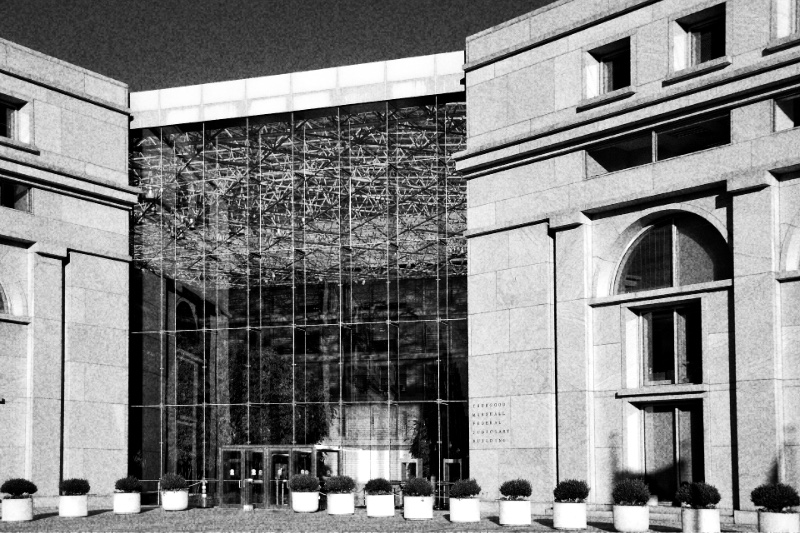
4300streetcar — CC BY 4.0, via Wikimedia Commons
The operative order in Maria L. v. Mullin is two pages long and stays one thing: a rule. Judge George A. O’Toole Jr. of the U.S. District Court for the District of Massachusetts signed it, and it provides that the 2025 interim final rule on immigration civil penalties, “and all fines issued thereunder, are hereby STAYED pending further Order of this Court.” It does not strike the statute that authorises the fines, and it does not touch anyone’s removal order.
The departments that wrote the rule have answered with another one. A final rule from the Department of Homeland Security and the Justice Department’s Executive Office for Immigration Review is on public inspection at the Federal Register and scheduled for publication on Wednesday 14 October. It “finalizes the IFR with one change”: ICE may accept a late appeal where a documented mail delay was beyond the person’s control. It takes effect on the day it is published.
The court’s opinion and order are both dated and file-stamped 30 September. Jurist reported the ruling as issued on Monday 5 October, and the final rule itself refers to “the entry of the stay on October 5, 2026.” The form of relief is not in doubt. The plaintiffs asked for a stay under section 705 of the Administrative Procedure Act, and the order grants a stay “to preserve status or rights pending conclusion of the review proceedings.” It is not an injunction.
What the statute allows
Congress did authorise these fines, in 1996. Section 1324d of Title 8 provides for a fine of “not more than $500 . . . for each day” that a person under a final order of removal “willfully fails or refuses to” depart, to apply in good faith for travel documents, or to present for removal. A second provision, 8 U.S.C. § 1229c(d), covers people granted voluntary departure who voluntarily fail to leave, with a fine of $1,000 to $5,000. The opinion records that inflation adjustment now puts those figures at $998 a day and $1,992 to $9,970.
The penalties, the opinion says, “have apparently never been imposed to any significant degree.” An executive order in 2017 directed their collection, President Biden revoked it in 2021, and an order on 20 January 2025 revived it. By June 2025 ICE had reportedly initiated almost 10,000 notices of intent to fine for failure to depart.
The large totals are arithmetic. The opinion records a fine of $1.82 million against one plaintiff, Nancy M. At $998 a day that is about five years: 998 × 365 × 5 comes to $1,821,350. That is this publication’s calculation; the opinion does not say how the figure was reached. Nancy M. was in the country under an order of supervision when she was fined, the court noted, and has since been approved for an immigrant visa and admitted as a lawful permanent resident.
So the authority question has a short answer: DHS has a statute. The dispute is over what the statute requires before a fine is imposed. The interim final rule, published jointly by the two departments on 27 June 2025, replaced procedures that dated largely from the 1950s. As the opinion summarises it, penalties now issue as final decisions rather than after a notice of intent to fine, are served by regular mail rather than in person or by certified mail, and allow fifteen days to respond instead of thirty, with no in-person interview. The final rule describes the other change as “the shift from BIA review to internal DHS review.”
What the court found
The judge found the plaintiffs likely to succeed on two arguments. The first is that the rule is contrary to law. The rule and the practice built on it, the opinion says, “effectively read the words ‘voluntarily’ and ‘willfully’ out of the relevant statutory provisions.” The court pointed to the nearly 10,000 notices initiated between March and June 2025, a pace it said belies the argument that each case was individually evaluated for willfulness or voluntariness.
The second is procedural. “The defendants do not dispute that they failed to follow the APA’s notice and comment requirements,” the opinion says. They relied on two exceptions. The court rejected the foreign affairs exception, finding that coordination with other governments over removals “only indirectly implicate[s] international relations, if at all.” On the procedural exception it split the rule. Service by regular mail could be an “internal house-keeping” measure. Issuing penalties directly, without a notice of intent, and cutting the appeal window to fifteen days were not. Of the shorter window the judge wrote: “That provision seems to be essentially punitive.”
What the stay stops and what it leaves
The stay covers the rule and the fines issued under it. It leaves the statute, and it leaves the older procedure. Granting it, the judge wrote, “would only require them to utilize the same procedures that governed the assessment of penalties prior to the IFR.” He added that the government could collect later if the penalties are ultimately enforced.
The order does not mention refunds, seized tax refunds or referrals to debt collectors, though the opinion records that some recipients described all three. It does not limit itself to the named plaintiffs, but the opinion calls the case a “putative” class action, so no class has been certified. None of the sources reviewed for this piece says how DHS is applying the stay to people who are not parties.
The scale is also disputed. Jurist, citing a DHS announcement of 23 July, reports more than 103,000 fines worth about $84 billion. A footnote in the opinion says the record before the court showed over 65,000 penalties totalling roughly $36 billion. Neither source explains the gap.
A final rule that arrives on Wednesday
The final rule does not retreat on willfulness. “In all cases, ICE considers the willfulness of an alien’s violation in determining whether to impose a penalty,” it says, and it relies on the warnings immigration judges are required to give, and on a presumption that they gave them, to support that finding. It keeps direct issuance, the fifteen-business-day appeal deadline and internal DHS review.
It also explains why it takes effect at once rather than after the usual thirty days under 5 U.S.C. § 553(d). The departments invoke good cause, say the public “operated under the rule’s provisions for more than a year”, and address the court directly: “The fact that the IFR’s effective date was recently stayed does not change the Departments’ determination.”
The stay, by its text, names the interim rule at 90 Fed. Reg. 27439. A final rule is a separate agency action, and the order does not mention it. Whether the stay reaches it, and whether the plaintiffs must return to court for fresh relief, are questions no filing reviewed for this piece has yet answered. The court’s first ground was how the rule was made, and the comment period that has now closed is the departments’ answer to that. The second was what the rule presumes. On Wednesday the presumption will be in the Federal Register again, with a mail-delay exception added.
Sources
The order’s terms are from the order of 30 September (Docket 114), and the statutory figures, history, findings and quotations from the opinion and order of the same date (Docket 113). The final rule’s terms, its publication date and its reference to the stay are from the public inspection copy, Federal Register document 2026-21024. The 2025 procedures are from the interim final rule at 90 Fed. Reg. 27439. The DHS totals are as reported by Jurist. The day-rate arithmetic is this publication’s.
Further reading
- Opinion and Order, Maria L. v. Mullin, No. 25-13471-GAO (D. Mass.), Docket 113U.S. District Court, District of Massachusetts
- Order staying the interim final rule, Maria L. v. Mullin, Docket 114U.S. District Court, District of Massachusetts
- Imposition and Collection of Civil Penalties for Certain Immigration-Related Violations (final rule, public inspection)Federal Register
- Imposition and Collection of Civil Penalties for Certain Immigration-Related Violations (interim final rule, 90 FR 27439)Federal Register
- 8 U.S. Code § 1324d, Civil penalties for failure to departLegal Information Institute
- US judge blocks Trump administration’s attempt to fine migrants who fail to willingly deportJurist
Ruth Okonkwo writes for The 13th Bell on law. This piece was edited and fact checked before publication.
Get The 13th Bell in your inbox