A Declaration Is Not a Treaty
Two hundred signatures asked governments to agree red lines for artificial intelligence by the end of this year. The request named no instrument, and the instrument is the whole question.

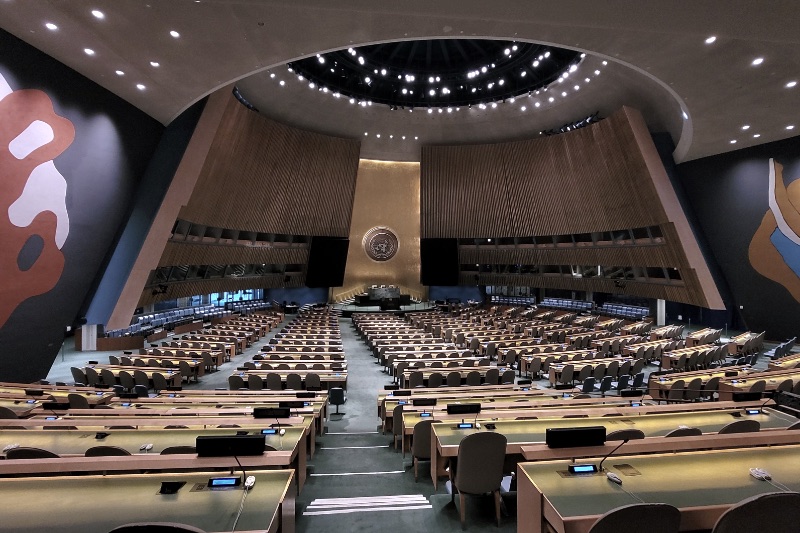
Basil D Soufi — CC BY-SA 3.0, via Wikimedia Commons
A year ago, during the high-level week of the General Assembly, a declaration was launched asking governments to agree on what artificial intelligence should never be permitted to do, by the end of 2026.
More than two hundred people signed it, including ten Nobel laureates and two former heads of state. The year has fifteen weeks left. Nothing binding exists, and the reason is contained in the word declaration.
International law recognises a hierarchy of instruments, and the distance between the top and the bottom is the distance between an obligation and an opinion.
The Vienna Convention on the Law of Treaties defines the top of it: an international agreement concluded between states in written form and governed by international law, whatever it is called.
The last clause matters. Calling something a declaration, an accord or a memorandum does not settle its status; what settles it is whether states intended to create legal obligations and expressed that intention in the accepted forms.
Those forms have steps. A text is negotiated, then signed, and signature is not consent to be bound -- it is agreement on the text and an undertaking not to defeat its object while ratification is considered.
Ratification is the binding act, and it happens at home. In the United States the advice and consent requirement means two-thirds of the Senate, a threshold no arms control treaty has cleared since the 1990s.
Then the treaty must enter into force, usually when a stated number of states have ratified, and it binds only those that did. A treaty with three parties is a treaty; it is not a global rule.
Below treaties sit resolutions. The Charter's own description of what the Assembly may do is candid about their force: the General Assembly may discuss, and it may recommend.
Recommendations are not nothing. They establish that a practice has been condemned, they give domestic legislators something to cite, and repeated often enough they contribute to the custom from which binding law is eventually built.
But they are adopted by states, and the declaration in question was not. It was signed by individuals -- eminent ones, with no capacity to bind the governments they used to lead.
That places it below even a resolution in the hierarchy: an open letter, which is a petition addressed to the people who hold the pen.
None of this makes such letters pointless. The treaty banning landmines and the convention on cluster munitions both began with campaigns from outside government, and both ended as binding instruments with dozens of parties.
Each took years, and each succeeded because a coalition of middle powers was willing to conclude a treaty without the largest military powers, accepting a narrower ban in exchange for having one at all.
The declaration on artificial intelligence asked for something harder: an agreement by a fixed date, with enforcement, and an independent organisation to implement it.
the chemical weapons convention and its inspectorate is the model for that last part, and it shows the price. Verification means inspectors with a right of entry to industrial sites, and states accept it only when they believe rivals are accepting it too.
For a technology whose civil and military versions are the same research, that machinery has no obvious shape. There is no chokepoint equivalent to a precursor chemical, and no declaration of stockpiles to inspect.
So the useful question about any AI governance proposal is not whether it is ambitious. It is which instrument it becomes: a treaty with ratifications, a resolution with a vote, a domestic statute, or a letter.
The instruments that have actually changed behaviour this decade are the least ceremonial ones -- export controls, procurement conditions and licensing terms, which bind because a company needs a permit rather than because a state gave consent.
A red line enforced by a customs schedule is not the agreement the signatories asked for. At present it is the only kind that exists.
Further reading
- Vienna Convention on the Law of Treaties, 1969United Nations Treaty Collection
- Charter of the United Nations, full textUnited Nations
- Chemical Weapons ConventionOrganisation for the Prohibition of Chemical Weapons
Nadia Belkacem writes for The 13th Bell on world. This piece was edited and fact checked before publication.
Get The 13th Bell in your inbox